Termites in Florida don't behave the same way, don't live in the same places, and don't respond to the same treatment. A method that wipes out one species can leave another untouched inside your walls.
What Do Termites Look Like in Florida?
Most people spot one of three things first: swarmers, workers, or damage.
Swarmers are the winged reproductives that leave the colony to start new ones, and they are what usually triggers the call. A termite swarmer has two pairs of wings the same length that stretch well past its body, straight beaded antennae, and a thick, uniform waist. Flying ants have bent antennae, a pinched waist, and front wings that are clearly longer than the back pair. That one comparison settles most identifications, though confusion between termites and carpenter ants sends many homeowners down the wrong path before anyone inspects the wood.
Workers are the ones doing the actual damage. They are creamy white to translucent, about an eighth of an inch long, and scatter quickly when exposed to light. If you crack open a piece of trim and see soft white insects, you have an active colony, not old damage.
Soldiers have enlarged amber or orange heads with visible jaws. A pest control technician uses soldier head shape to confirm species, so if you find one, save it in a plastic bag or a jar.
The Types of Termites in Florida Homeowners Actually Encounter
Florida hosts more termite species than any other state in the continental U.S., and the warm, humid coastline running through Miami-Dade, Broward, and Palm Beach counties gets the heaviest pressure. The different types of termites in Florida fall into four groups, and those four account for almost every infestation we treat.
Drywood Termites
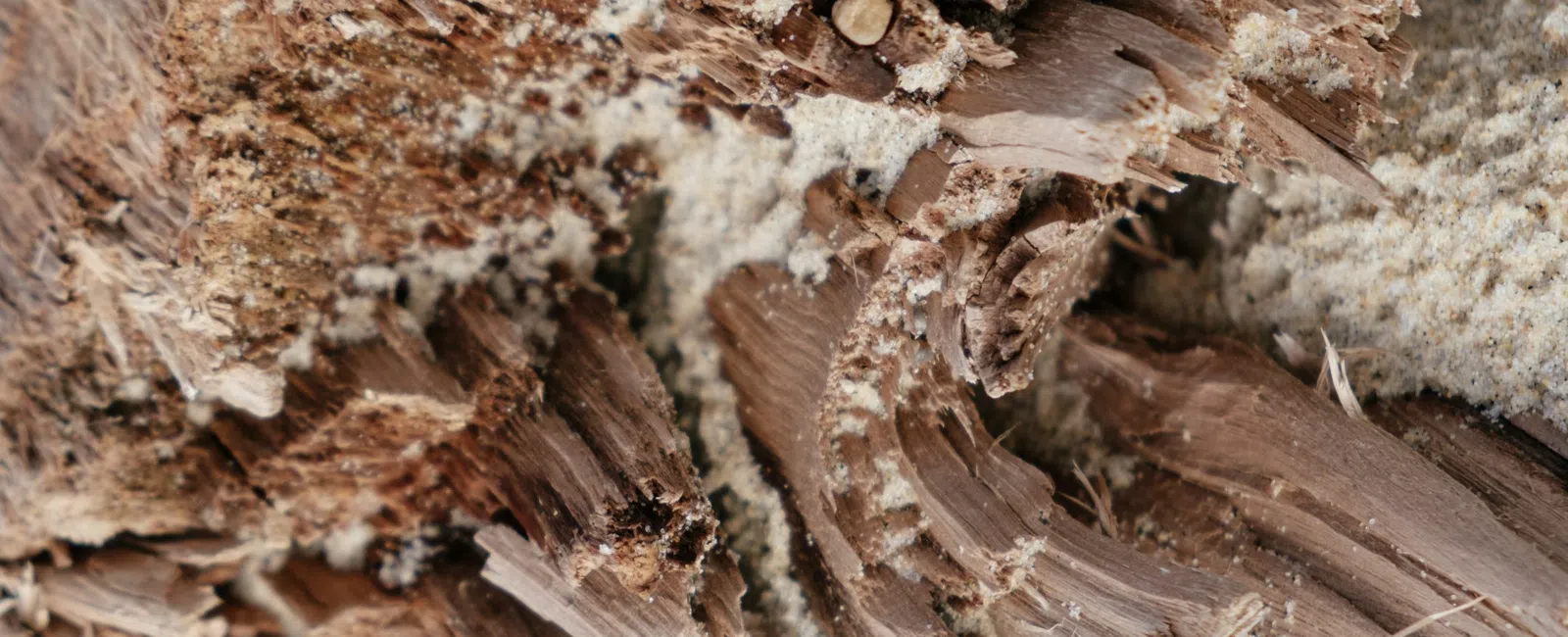
Drywood termites live entirely inside the wood they eat. No soil contact, no moisture requirement, no connection to the ground. That is what makes them the dominant problem in South Florida homes, especially in attic rafters, door and window frames, hardwood floors, and furniture.
The West Indian drywood termite is the most destructive of the group. Its calling card is frass: tiny six-sided pellets, tan to dark brown, that pile up below a small kick-out hole. If you sweep up what looks like sawdust or sand and it comes back a few days later, that is an active drywood colony above it. Swarms usually happen in late spring and early summer, often at dusk.
Frass is a critical sign to look for when inspecting for drywood termites.
Subterranean Termites
Subterranean termites live in the soil and travel up into a structure through mud tubes, which are pencil-width tunnels of dirt and saliva running along foundation walls, slab edges, and pilings. They need moisture, so leaking irrigation lines, clogged gutters, and wood-to-soil contact are what invite them in. Eastern subterranean termites swarm during daylight hours in late winter and spring, and their behavior around foundations is worth understanding before you plan any treatment.
Formosan and Asian Subterranean Termites
These two invasive species are why South Florida termite work differs from the rest of the state. Both build enormous colonies, sometimes numbering in the millions, and both can chew through structural lumber far faster than native subterraneans. Asian subterranean termites tend to swarm from February into April at dusk, and Formosans from April into June after dark.
Researchers have documented the two species swarming at the same time in South Florida and producing hybrid colonies, which homeowners elsewhere in the country don't deal with. If you live in Fort Lauderdale, Hollywood, Miramar, or anywhere along the coastal corridor, this is the group that justifies an annual inspection.
Dampwood Termites
Dampwood termites are the largest of the Florida species and the least common in maintained homes. They need wood that is already wet and decaying, so they show up in rotted fence posts, tree stumps, and around chronic plumbing leaks. Finding them usually points to a moisture problem that needs fixing along with the termites.
Types of Termite Treatment and When Each One Makes Sense
Once the species is confirmed, the treatment choice narrows quickly.
No-tent treatment. For a drywood infestation confined to a specific area, termiticide foam is injected directly into the galleries inside walls, door frames, and window frames. Nobody moves out, nothing gets tented, and the treatment is finished the same day. This works when the colony is localized and accessible.
Fumigation. When drywood termites are spread across the attic, multiple walls, and several rooms, or when separate colonies are active in different parts of the house, tenting is the only method that reaches all of them at once. The structure is sealed, and a fumigant gas penetrates every crack and every piece of wood. Plan on two to four days, with most families back home by the end of the third. Knowing what to expect after a fumigation service makes the preparation much less stressful.
Liquid termiticide barrier. For subterranean and Formosan termites, technicians trench the soil around the foundation and apply a continuous liquid barrier the colony cannot cross. Royal Pest uses pet-safe liquid termiticide, which matters in a house with a dog that treats the yard as its own. A barrier holds for roughly five years.
Bait stations. Bait stations installed every 10 to 20 linear feet around the foundation are the strongest preventive option for subterranean termites. Workers carry the active ingredient back to the colony, and monitoring catches new activity before it reaches your framing.
Depending on the method, professional termite treatment protects a home for about 6 to 10 years, which is why getting the initial identification right matters.
Which Treatment Does Your Home Need
Pellets and kick-out holes point to drywood termites, and whether you need a no-tent treatment or fumigation depends on how far it has spread. Mud tubes point to subterranean termites and a soil barrier or bait system. Winged swarmers alone tell you a colony is nearby but not where it lives, and that takes an inspection.
If you are still unsure, the earliest signs of a termite infestation are easy to miss, and a licensed inspector will confirm the species before anyone quotes you a price.
Get a Free Termite Inspection in South Florida
Royal Pest & Termite, a proud member of the Florida Pest Management Association, has been protecting homes across Miami-Dade, Broward, and Palm Beach counties with products chosen to be safe for kids and pets, the same standard that has kept us at 4.8 stars across 173 Google reviews. Inspections and estimates are free, and every treatment is backed by our guarantee with free call-backs.
Call us today to schedule a free termite inspection and find out what is living in your walls before the next swarm season.