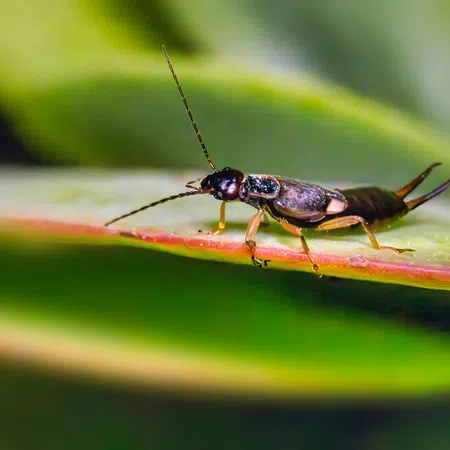
Earwigs are the dark brown, half-inch insects with pincers on the tail end that turn up in a South Florida bathroom, laundry room, or kitchen after a heavy rain or a long dry spell. They do not bite, the pincers rarely break skin, and the story about them crawling into ears is folklore. What they do reliably is show up indoors in numbers whenever the mulch beds and irrigated soil around a house swing too wet or too dry, and that pattern repeats through the year here.
What Earwigs Are
Earwigs belong to the insect order Dermaptera, and the feature everyone notices is the pair of curved forceps, called cerci, at the rear of the abdomen. Males carry the more strongly curved set, and females a straighter one. The body is slender and flattened, usually a half inch to three quarters of an inch long, dark reddish brown to nearly black, with short leathery forewings and a pair of folded hindwings underneath. Most earwig species can fly, but they almost never do, and the species that dominates in South Florida, the ringlegged earwig, has no wings at all. The larger striped earwig turns up in sandy yards along the coast.
Earwigs are nocturnal. By day they pack into tight, dark, damp spaces: under mulch, leaf litter, pavers, planters, landscape stones, the lip of a pool deck, and the moist soil of a shrub bed on an irrigation schedule. At night they come out to feed on decaying plant material, aphids, mites, and other small soft-bodied insects, along with the occasional seedling or flower petal. Females lay eggs in a chamber in the soil and guard them until the nymphs hatch, which is unusual for an insect and part of why a single bed can produce large numbers over a summer.
Do Earwigs Bite and Are They Dangerous
Earwigs do not bite. If one is picked up or trapped against skin, it can pinch with its cerci, and a large striped earwig can pinch hard enough to feel it, but the pincers rarely break the skin and there is no venom involved. Earwigs do not carry disease, do not sting, and do not damage wood, wiring, fabric, or stored food. They do not infest a home the way cockroaches or ants do, because they need soil to reproduce and cannot sustain a population indoors.
The reason earwigs still earn a service call is the volume. A house with heavy mulch against the foundation and sprinklers wetting the walls can take in dozens a night, and finding them in sinks, tubs, under bath mats, and in clean laundry is a problem most homeowners want solved rather than tolerated. In a garden they can chew young seedlings and soft flower petals, which is the one place they cause real damage.
Where Earwigs Come From and Why They Get Inside
Earwigs come from the yard, and almost every indoor sighting traces to the strip of ground within a few feet of the exterior walls. Two conditions push them indoors.
- Heavy rain saturates the soil and mulch, and earwigs move up and out of flooded harborage toward the dry slab, door thresholds, and garage openings.
- A dry stretch, especially after the rainy season ends in the fall, dries out the beds, and earwigs follow moisture to the places that still have it: plumbing areas, bathroom floors, laundry rooms, and the soil of potted plants.
They get in through the same openings every crawling pest uses. The gap under an exterior door with a worn sweep, the seam where a sliding glass door meets its track, the garage door seal, weep holes, utility penetrations where the AC line and hose bibs come through the wall, and cracks at the foundation. Potted plants carried inside bring them too, since the moist soil in the pot is exactly the harborage they prefer.
How We Get Rid of Earwigs
Earwig control is a perimeter problem, and treating the ones inside without treating the ground they came from means a new batch the next wet night. Our year-round pest control plan is built to stop earwigs, centipedes, and millipedes in the transition zone between the yard and the house, before they reach a door.
On every visit, our technicians apply a professional-grade barrier three feet up the exterior walls and three feet out onto the lawn, which covers the foundation, the lower wall, and the mulch strip where earwigs harbor by day. The treatment goes around every door, window, and garage opening, and around the utility penetrations and pipe entries they slip through. Those that cross the treated band on their way to a threshold do not make it inside.
Inside the home, treatment targets the areas where they are found once they do get in. Products are applied in cracks and crevices along baseboards, around kitchen and bathroom plumbing, under sinks, and at interior door and window frames, not sprayed across open floors. Every product we use is selected to be safe for children and pets once it dries.
The plan runs on a quarterly schedule timed to the seasons that drive earwigs indoors. The summer visits hold the barrier through the rainy months when flooded beds send them to the slab, and the October and November visit covers the fall transition when drying soil sends them toward indoor moisture. If earwigs or any other covered pest show up between visits, we come back at no additional charge.
Conditions That Keep Earwigs Coming Back
A barrier treatment does its job best when the ground against the house is not working against it. On the inspection that starts every service, our technicians look at the mulch depth at the foundation, shrubs and ground cover pressed against the walls, and sprinkler heads that throw water onto the siding, because those are the three conditions that keep the population high within reach of the doors. Where irrigation overspray is soaking the perimeter, our irrigation and sprinkler maintenance service adjusts the heads and repairs leaking zones so the barrier is treating dry ground instead of a wet one.
If you are finding earwigs in bathrooms, laundry rooms, or kitchens anywhere in Miami-Dade, Palm Beach, or Broward County, schedule a free inspection. We will identify what is coming in, where it is entering, and treat the perimeter that is sending it.