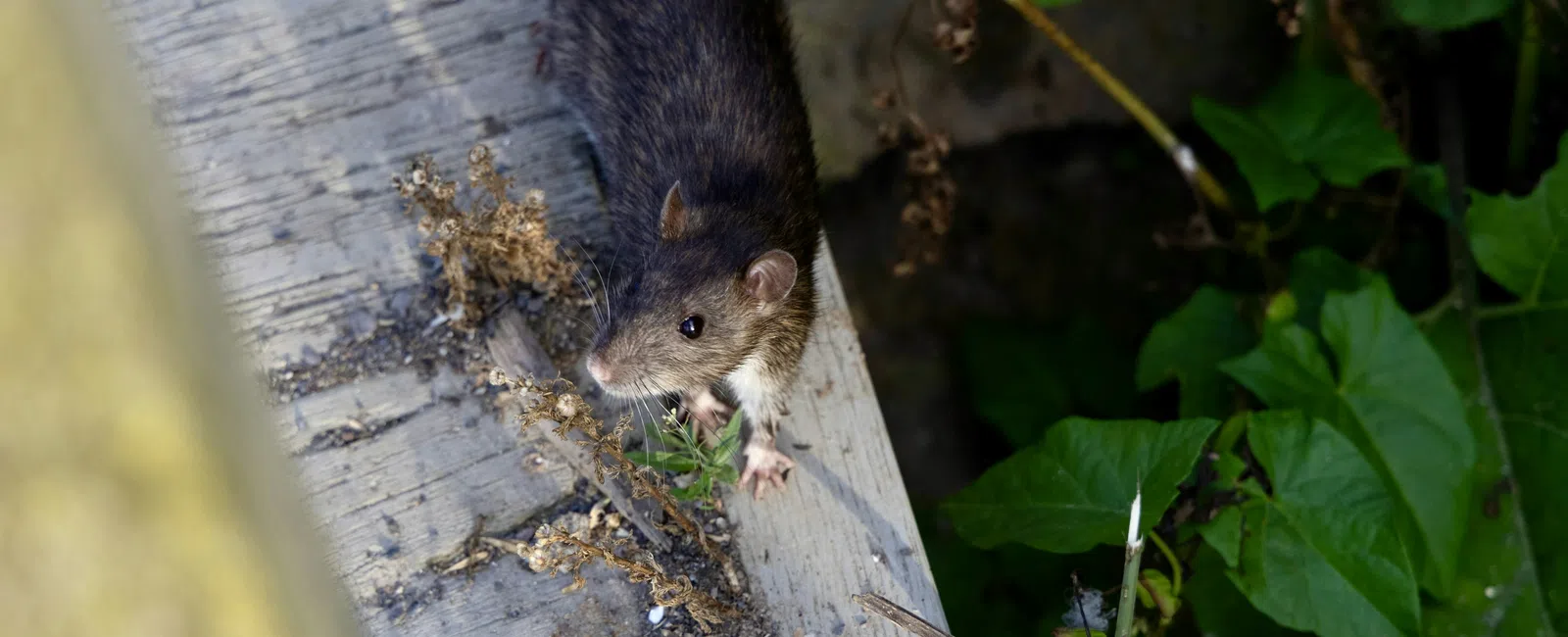
What Rat Droppings Look Like
South Florida homes mainly deal with the roof rat, and its droppings can be up to half an inch long, spindle-shaped, and tapering to a point at both ends. They are dark when they are new.
The Norway rat, far less common here, leaves something noticeably bigger and blunter: around three-quarters of an inch, capsule-shaped, with rounded rather than pointed ends. Finding these usually means ground level, since this is a burrowing animal rather than a climbing one.
Both are dramatically larger than mouse droppings, which are about an eighth of an inch and rod-shaped. Droppings are one tell among several. Tail length and ear size separate mice from rats just as reliably as does the diameter of the hole they came in through.
Fresh Or Old Is The Most Useful Thing You Can Read
This detail changes what happens next, and almost nobody checks it.
Fresh droppings are black, shiny, and putty-like. Old droppings are gray, dusty, and crumble when disturbed. That single distinction separates an active problem from a historical one, and the two call for very different responses. A garage full of gray, crumbling droppings may be a record of something that ended two years ago. A handful of black, shiny ones under the sink means an animal was there recently.
Two other signs age the same way. Rats leave dark, greasy rub marks where their bodies brush along a travel route, and new marks smudge under a finger while old ones are brittle and flake. Runways also tell you: if the path has undisturbed dust or cobwebs across it, it is no longer being used. Rodent urine also fluoresces blue-white under ultraviolet light while it is fresh, which is why inspections are often done with a UV light rather than a flashlight.
What Gets Mistaken For Rat Droppings In South Florida
Many of the specks homeowners photograph and ask about, convinced they're rat poop, were left by something else entirely, and this region produces more false alarms than most.
Lizard and gecko droppings are the most common mix-up here. They are a similar size and dark color, but a reptile passes uric acid along with waste, so one end carries a distinct chalky white cap. Rodent droppings are uniformly dark with no white tip. Once you know to look for the white end, the two stop looking alike.
Squirrel droppings are rounder and more barrel-shaped than a rat's, usually lighter brown, and a bit thicker through the middle without the tapered points. They also turn up in attics, which is exactly where the confusion happens.
Cockroach droppings are much smaller and, on the larger species, carry visible ridges running lengthwise with blunt ends, closer to coarse pepper or coffee grounds than to a grain of rice.
Bat guano is roughly rat-sized but falls apart into shiny flecks when crushed, because it is made almost entirely of insect fragments.
Where You Find Them Narrows It Down Further
Rodents tend to have preferred toilet areas but will go more or less anywhere they travel, so the distribution is informative.
Pellets concentrated along a wall, behind stored items, or on top of ceiling joists mark a runway. Outdoors, look for trails two to three inches wide worn into hard-packed earth under vegetation and along fence lines. Scattered widely across a floor rather than following a line, they usually indicate a larger population than one keeping to a single defined path.
Height matters in South Florida specifically. Droppings in an attic, along rafters, on top of ductwork, or in insulation point to roof rats, which nest off the ground and travel overhead. The roof rat identification markers are worth reviewing if that is where yours are turning up.
Are Rat Droppings Dangerous
Yes, and this is the part worth taking seriously rather than shrugging off.
Rodents and their waste are associated with leptospirosis, salmonellosis, rat-bite fever, hantavirus, and lymphocytic choriomeningitis, among others. People become infected through direct contact with droppings, urine, or saliva; by eating food contaminated with rodent waste; through bites and scratches; and through the fleas, mites, and ticks rodents carry.
The route that catches people out is airborne. Health authorities are explicit that these diseases spread to people mainly by breathing contaminated air, and disturbed dried droppings release particles into that air. A rodent carrying something transmissible looks exactly like one that is not, so there is no way to assess risk by looking at the animal or its droppings.
Why Sweeping Or Vacuuming Is The Wrong First Move
This is the single most common mistake, and it makes the situation worse rather than better.
Sweeping and vacuuming rodent droppings, urine, or nesting material send fine particles into the air, which is precisely the exposure route that matters. A vacuum does not contain them; it distributes them. Health guidance is to ventilate a closed space for about half an hour, with nobody in it, before anyone begins working in there at all, and to wet contaminated material down rather than stir it up dry.
That's why droppings in an attic or wall void aren't really a housekeeping job. The material has to be wetted, handled with protection, and removed rather than swept, and contaminated insulation frequently has to come out with it.
What Finding Droppings Should Actually Trigger
Droppings answer whether something is living in your house. They do not answer how it got in, how many there are, or whether the route is still open, and those are the questions that determine whether this recurs next season.
A few things shift the urgency. Seeing a rat during daylight suggests a large population rather than a lucky sighting. Fresh droppings in more than one area of the house suggest more than one travel route. Droppings in insulation or near wiring raise a damage question on top of the health one.
Working out which of those apply is an inspection rather than a guess, and it covers ground a homeowner cannot easily reach: where the runways actually run, which gaps are in use, whether the population is nesting inside the structure or commuting in from the landscaping, and how much contaminated material needs to come out. Rodent control that removes the animals without closing the route just resets the clock, and the droppings come back.
At Royal Pest & Termite, every product we use in an attic, a kitchen, or along a foundation is chosen to handle rodents while staying safe for kids and pets, the same standard that has kept us at 4.8 stars across 173 Google reviews. We are licensed, insured, and a member of the Florida Pest Management Association, and we offer free inspections and estimates across our South Florida service areas in Miami-Dade, Broward, and Palm Beach counties, backed by a guarantee with free call-backs between scheduled visits.
Call us today to schedule a free rodent inspection and find out what is leaving them before the population behind them gets any bigger.