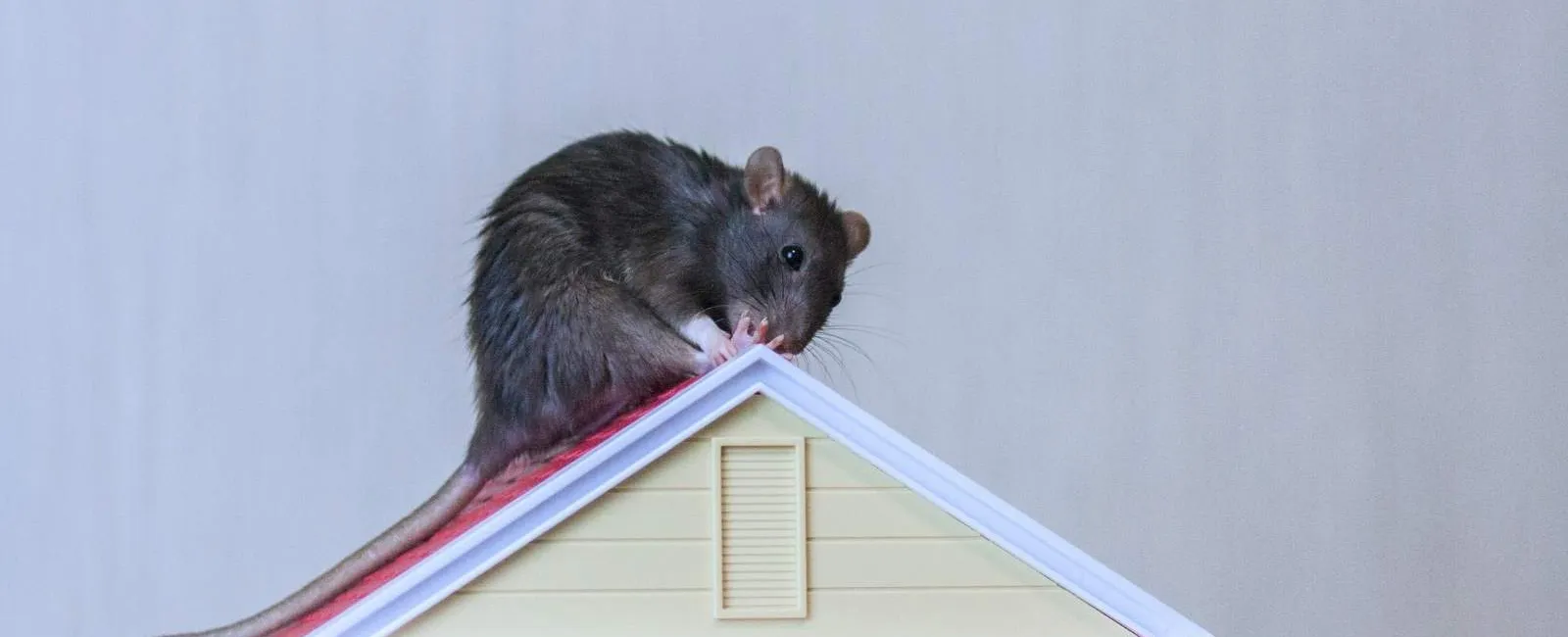
Roof rats are the dominant rodent pest in South Florida residential neighborhoods. Unlike the Norway rat more common in northern cities. Roof rats are agile climbers that prefer elevated harborage, palm trees, Spanish tile roofs, attics, and the canopy of mature landscaping found throughout Broward and Miami-Dade Counties. They are well-established across the region and active year-round in Florida's climate.
Most homeowners become aware of a roof rat problem when they hear scratching, gnawing, or movement sounds in the attic or ceiling, often at night when roof rats are most active. By the time those sounds are audible, the infestation is typically well-established.
Roof Rat vs. Norway Rat: Key Differences
South Florida homeowners occasionally confuse the two rat species, but the distinction matters for treatment because they behave differently and use different parts of a structure.
Roof rat:
- Slender body, 6 to 8 inches, with a tail longer than the body
- Large ears, pointed snout, smooth coat
- Dark brown to black in color
- Agile climber: lives in trees, attics, upper floors, and rooflines
- Primarily found throughout South Florida
Norway rat:
- Heavier body, 7 to 9 inches, with a tail shorter than the body
- Small ears, blunt snout, shaggy coat
- Brown to gray in color
- Ground dweller: burrows along foundations, in crawl spaces, and in sewers
- Less common in South Florida, more prevalent in northern cities
In Broward, Miami-Dade, and Palm Beach Counties, the overwhelming majority of residential rat infestations involve roof rats. If you're hearing sounds in the attic or seeing rats in trees and on rooflines, it's almost certainly a roof rat.
Why South Florida Is Ideal for Roof Rats
Roof rats thrive in tropical and subtropical environments. South Florida's climate, landscaping, and construction styles create conditions that sustain large populations of roof rats year-round.
- Citrus and fruit trees. Roof rats are strongly attracted to fruit. Homes with orange, grapefruit, avocado, mango, or other fruit trees provide a reliable food source that attracts roof rats. A single unmaintained fruit tree can sustain a roof rat colony and serve as the primary access route to your roof.
- Mature palm canopies. Queen palms, coconut palms, and Washingtonia palms with untrimmed skirts provide nesting material and harborage directly adjacent to rooflines. Roof rats travel along palm fronds and use overhanging vegetation as the primary bridge from trees to structures.
- Spanish tile roofing. The gaps under Spanish tile roofs are a common entry point for roof rats. The curved tiles create natural voids that roof rats can access from the roofline, providing direct entry into the attic without any structural penetration.
- Year-round breeding. Florida's climate allows roof rats to breed continuously. A breeding pair can produce 40 or more offspring per year under ideal conditions. Without seasonal suppression, populations in established colonies grow steadily.
- Dense residential landscaping. The lush, mature landscaping common in South Florida's established neighborhoods creates an interconnected canopy network that roof rats use to move between properties. An active colony on one property creates pressure on adjacent homes.
Signs of Roof Rats in Your Home
Roof rat infestations are often discovered through sound before any visual confirmation. Common indicators include:
- Sounds in the attic or ceiling. Scratching, scurrying, rolling, and gnawing sounds in the attic or ceiling space, particularly at night, are the most common first sign. Roof rats are nocturnal and most active after dark. The sounds often track across the ceiling as the rats move between harborage and feeding areas.
- Roof rat droppings. Roof rat droppings are spindle-shaped, approximately 12mm long, with pointed ends. Distinguishable from mouse droppings (smaller) and Norway rat droppings (blunt ends). Fresh droppings are dark and moist; older droppings are dry and gray. Droppings are typically found along travel routes: along wall edges, near entry points, in the attic, and around food sources.
- Gnaw marks. Roof rats gnaw continuously to keep their incisors worn down. Fresh gnaw marks are light-colored; older marks darken over time. Look for gnaw marks on wood framing in the attic, along the roofline, on PVC pipe, and on food packaging in the pantry.
- Grease marks and rub marks. Roof rats follow consistent travel routes and leave dark grease marks along surfaces they contact regularly. These rub marks appear on pipes, beams, wall edges, and entry points.
- Nesting material. Roof rats build nests from shredded insulation, palm fronds, plant fibers, and other soft materials. Nests are typically found in attic insulation, wall voids, or dense vegetation adjacent to the structure.
- Visual sightings at dusk. Roof rats become active at dusk and are occasionally visible running along fence tops, rooflines, power lines, and tree branches. Sightings in these locations at dusk or dawn are a reliable indicator of an active colony nearby.
- Damaged fruit. Fruit trees with partially eaten or hollowed-out fruit, particularly citrus, are a strong indicator of roof rat activity in the yard.
Are Roof Rats Dangerous?
Roof rats pose health and structural risks that make professional control necessary rather than optional.
- Disease transmission. Roof rats pose several disease risks, including leptospirosis (transmitted through urine contact), rat-bite fever, and salmonellosis (through food contamination). Their droppings and urine can contaminate insulation, HVAC systems, and any food storage they access.
- Structural damage. Roof rats gnaw through wood framing, PVC plumbing, and electrical wiring. Gnawed electrical wiring in the attic is a documented fire hazard. Damage to plumbing inside wall voids can cause leaks that go undetected for extended periods.
- Contaminated insulation. An established roof rat colony in the attic deposits droppings and urine throughout the insulation over time. In severe infestations, full insulation removal and replacement is the appropriate remediation, not just rodent control.
How to Get Rid of Roof Rats
Effective roof rat control requires three components working together: exclusion, trapping, and population management. Addressing any single component without the others results in recurring infestation.
Step 1: Inspection and identification of entry points. The first step is a thorough inspection of the roofline, attic, and exterior of the structure to identify how and where rats are entering. Common entry points include gaps under Spanish tile, roof vents without proper screening, openings around HVAC penetrations, utility line entries, and gaps in the soffit. Roof rats can enter through openings as small as half an inch.
Step 2: Exclusion: closing entry points. Identified entry points are sealed with materials rats cannot gnaw through, such as galvanized hardware cloth, metal flashing, or copper mesh. Standard caulk and foam insulation are not adequate; roof rats will chew through them. Exclusion is the only permanent solution. Trapping without exclusion reduces the current population while leaving the entry routes open for recolonization.
Step 3: Trapping. Snap traps are the most effective and reliable method for eliminating roof rats inside a structure. Placed along travel routes in the attic, along wall edges, and near identified entry points, properly set traps with appropriate bait (peanut butter, nesting material, fruit) are highly effective when positioned correctly. Glue traps and live traps have significant limitations for attic-based roof rat infestations and are not the preferred professional method.
Step 4: Exterior population management. Tamper-resistant bait stations placed in the yard and along fence lines reduce the exterior population that is continuously pressuring the structure. These stations are secured so only rodents can access the bait, making them safe for use in yards with children and pets when properly installed and maintained.
Step 5: Habitat modification. Trimming vegetation that contacts the roofline removes the primary access route. Removing or netting fruit trees eliminates the food source, drawing roof rats to the property. Clearing palm skirts removes nesting harborage adjacent to the structure. These modifications reduce pressure on the property regardless of what other treatment is in place.
Our rodent control services cover the full process: inspection, exclusion, trapping, and exterior bait station programs for ongoing protection.
Scheduling a Rodent Inspection
Roof rat infestations are most effectively addressed early. Audible activity in the attic should prompt an inspection before the colony has time to expand, further contaminate the insulation, or cause additional structural damage.
Royal Pest & Termite is locally owned, based in Miramar, and has been serving South Florida homes since 2014. Our technicians inspect the roofline, attic, and exterior, identify entry points, and provide a clear picture of the infestation and the control required.
Call us at (754) 202-4605 or schedule a free inspection online.
We serve Miramar, Pembroke Pines, Davie, Hollywood, Fort Lauderdale, Boca Raton, South Palm Beach County, and most of Broward County, FL. We also service select areas in northern Miami-Dade County. Call us to confirm availability at your address.