Chinch bugs are the most destructive lawn pest in South Florida. The southern chinch bug feeds almost exclusively on St. Augustine grass, which is the dominant residential turf throughout Broward, Miami-Dade, and Palm Beach Counties. During South Florida's hot, dry periods, typically late spring through summer, chinch bug populations can expand rapidly and cause severe turf damage in a matter of weeks.
Because chinch bug damage is frequently mistaken for drought stress, fungal disease, or irrigation problems, infestations often go undetected and untreated until the damage is extensive.
What Are Chinch Bugs?
The southern chinch bug is a small insect, roughly 1/6 inch as an adult, with a black body and white wings folded across its back. Nymphs (juveniles) are initially red with a white stripe across the abdomen, gradually darkening to black as they mature through five growth stages before reaching adulthood.
Adults and nymphs both feed by piercing St. Augustine grass blades and extracting plant fluids. They also inject a toxin during feeding that disrupts the grass's water transport system, causing the grass to wilt and die even when soil moisture is adequate. This is why chinch bug damage is so easily mistaken for drought stress: the visual symptoms are almost identical, but watering has no effect on chinch bug-damaged turf.
A single female chinch bug can lay 200 to 300 eggs over her lifetime. In South Florida's climate, chinch bugs complete multiple generations per year without the winter interruption that slows populations in cooler states. High populations of several hundred bugs per square foot can develop in heavily damaged areas.
Identifying Chinch Bug Damage in Your Lawn
Chinch bug damage follows a consistent pattern that, when you know what to look for, distinguishes it from other turf problems.
- Irregular yellowing patches in full sun. Chinch bug damage almost always begins in the hottest, sunniest areas of the lawn, along south-facing edges, beside driveways and sidewalks, and in areas with reflected heat from walls or fences. Shaded areas of the same lawn are typically unaffected or affected last. This sun-preference pattern is one of the most reliable early indicators.
- Patches that expand outward over time. Unlike drought stress, which affects the lawn more uniformly, chinch bug damage spreads outward from a central point as the population moves to find new feeding grounds. A patch that is growing at its edges while the center turns brown and dies is consistent with active chinch bug feeding.
- Yellow turf that progresses to brown. Chinch bug feeding initially causes grass blades to yellow and wilt. As damage progresses, the grass dies and turns brown. Dead patches do not recover with irrigation, which helps distinguish chinch bug damage from drought stress that does respond to watering.
- Proximity to hard surfaces. Damaged areas frequently originate along or near sidewalks, driveways, curbs, and building foundations, surfaces that retain heat and create the warm, dry microenvironment that chinch bugs prefer.
- Presence of thatch. Lawns with thick thatch layers provide an ideal habitat for chinch bugs, which shelter and reproduce in the thatch zone. Heavy thatch accumulation is a consistent risk factor for chinch bug infestation.
How to Confirm a Chinch Bug Infestation
Visual inspection of the turf can confirm the presence of chinch bugs before committing to treatment. Two methods are commonly used:
- The flotation method. Cut both ends off a large coffee can or similar cylinder and press one end firmly into the soil at the edge of a damaged patch, in the transition zone between healthy and damaged turf. Fill the cylinder with water and maintain the water level for two to three minutes. Active chinch bugs will float to the surface. Finding five or more bugs per cylinder confirms a treatment-level infestation.
- Direct visual inspection. Part the grass blades at the edge of a damaged area and examine the thatch layer and soil surface closely. Chinch bugs move quickly when disturbed, so examination works best in the morning when temperatures are cooler and movement is slower. A hand lens helps with identification. Look for the characteristic red nymphs and black-and-white adults.
Confirming an active infestation before treating is important because the treatment options for chinch bugs, drought stress, and fungal disease are different and treating the wrong problem wastes time and money.
Chinch Bug Damage vs. Other Lawn Problems
Several common South Florida lawn issues produce symptoms similar to chinch bug damage. Correct diagnosis before treatment is essential.
Chinch bug damage vs. drought stress. Both cause yellowing and browning of St. Augustine grass. The key difference: drought-stressed turf recovers within a day or two of adequate irrigation. Chinch bug-damaged turf does not improve with watering. If your lawn isn't responding to irrigation during a dry period, chinch bugs are likely involved.
Chinch bug damage vs. brown patch fungus. Brown patch (Rhizoctonia solani) is a fungal disease that affects St. Augustine grass during cool, humid periods in South Florida, typically fall and winter. Chinch bug damage is most active during hot, dry conditions in late spring and summer. Brown patch produces circular patches with a smoky gray border; chinch bug damage produces irregular patches expanding from sunny edges. If damage occurs during the summer in full-sun areas, chinch bugs are the more likely cause.
Chinch bug damage vs. gray leaf spot. Gray leaf spot produces lesions on individual grass blades and is associated with overwatering and warm, humid conditions. Chinch bug damage kills turf at the root system level through toxin injection. Gray leaf spot does not produce the expanding patch pattern with hard-surface proximity that chinch bugs produce.
How to Get Rid of Chinch Bugs
Effective chinch bug control requires a combination of cultural practices and targeted insecticide treatment. Insecticide alone, without addressing the conditions that support high chinch bug populations, produces inconsistent results.
Step 1: Confirm the infestation level. Use the flotation method described above to confirm the presence of active chinch bugs and assess severity before treating. Light infestations in early stages can sometimes be managed with cultural practices alone. Heavy infestations require insecticide treatment.
Step 2: Reduce thatch. Thatch deeper than half an inch provides ideal harborage and reduces insecticide penetration. Power raking or vertical mowing to reduce thatch before treatment improves product efficacy and removes the sheltering zone that allows chinch bug populations to rebuild after treatment.
Step 3: Adjust irrigation. While chinch bugs thrive in dry conditions and dry soil accelerates damage, overwatering creates other problems (fungal disease, root rot). The correct approach is consistent, appropriate irrigation, not excessive watering in response to damage.
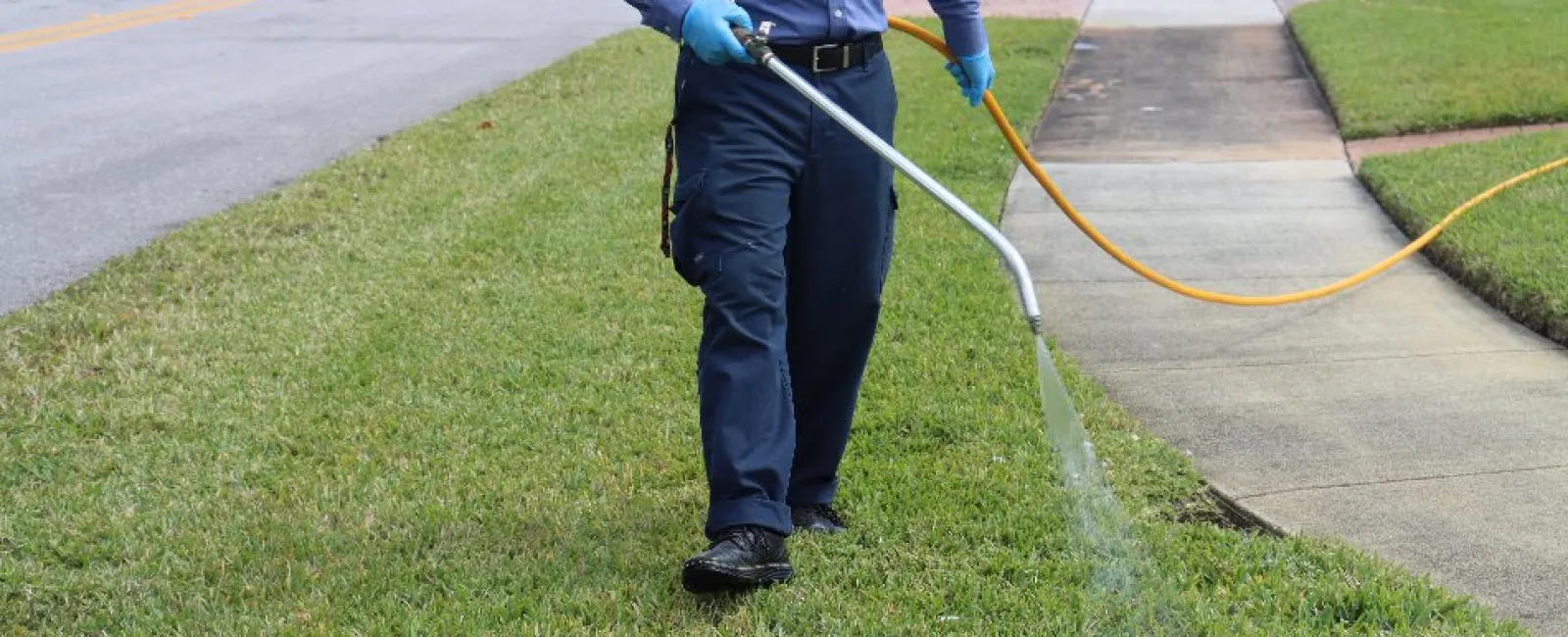
Step 4: Apply a professional-grade insecticide. Several active ingredients are effective against southern chinch bugs, including bifenthrin, lambda-cyhalothrin, and imidacloprid. Resistance to some pyrethroid insecticides has been documented in South Florida chinch bug populations, which is one reason over-the-counter products sometimes underperform. Professional-grade products applied at the correct rate and timing, particularly in the late morning when chinch bugs are most active near the soil surface, produce more consistent results than retail applications.
Step 5: Monitor and follow up. Eggs are less susceptible to most insecticides than nymphs and adults. A follow-up treatment 3 to 4 weeks after the initial application addresses the next generation as it hatches and begins feeding. Monitoring the treated area with the flotation method confirms whether the population has been controlled.
Our lawn insect control program addresses chinch bugs with professional-grade treatments calibrated for South Florida's specific chinch bug populations and St. Augustine turf conditions.
Chinch Bug Prevention
Ongoing cultural practices reduce the conditions that support chinch bug population growth.
Maintain proper mowing height. St. Augustine grass performs best and is most resistant to chinch bug stress when maintained at 3.5 to 4 inches. Scalping the lawn creates the open, hot microenvironment chinch bugs prefer.
Avoid excessive nitrogen fertilization. High nitrogen inputs produce rapid, lush growth that chinch bugs find highly palatable. A balanced, slow-release fertilizer program produces steady growth that is less attractive to chinch bug feeding and more resilient under infestation pressure.
Manage thatch proactively. Annual or biannual dethatching prevents the accumulation of thatch, which serves as chinch bug habitat.
Water consistently and correctly. Apply water early in the morning; irrigate deeply and infrequently rather than lightly and frequently; and avoid letting the lawn dry out severely during peak chinch bug season (May through September).
Consider tolerant varieties. If you are replacing a lawn or undertaking a major renovation, Floratam St. Augustine, while not immune, has historically shown more tolerance to chinch bug feeding than other St. Augustine varieties. Consult with a lawn care professional about variety selection for your specific conditions.
Schedule a Lawn Inspection
Chinch bug damage is most cost-effective to address in the early stages, before large sections of turf require replacement. If you are seeing irregular yellowing in sunny areas of your St. Augustine lawn during summer that is not responding to irrigation, an inspection is warranted.
Royal Pest & Termite provides lawn care and lawn insect control services throughout Broward County and surrounding South Florida communities. Our technicians identify the pest, assess the extent of damage, and recommend a treatment approach matched to the actual infestation rather than a standard package.
Call us at (754) 202-4607 or schedule a free lawn inspection online.
We serve Miramar, Pembroke Pines, Davie, Hollywood, Fort Lauderdale, Boca Raton, South Palm Beach County, and most of Broward County, FL. We also service select areas in northern Miami-Dade County. Call us to confirm availability at your address.