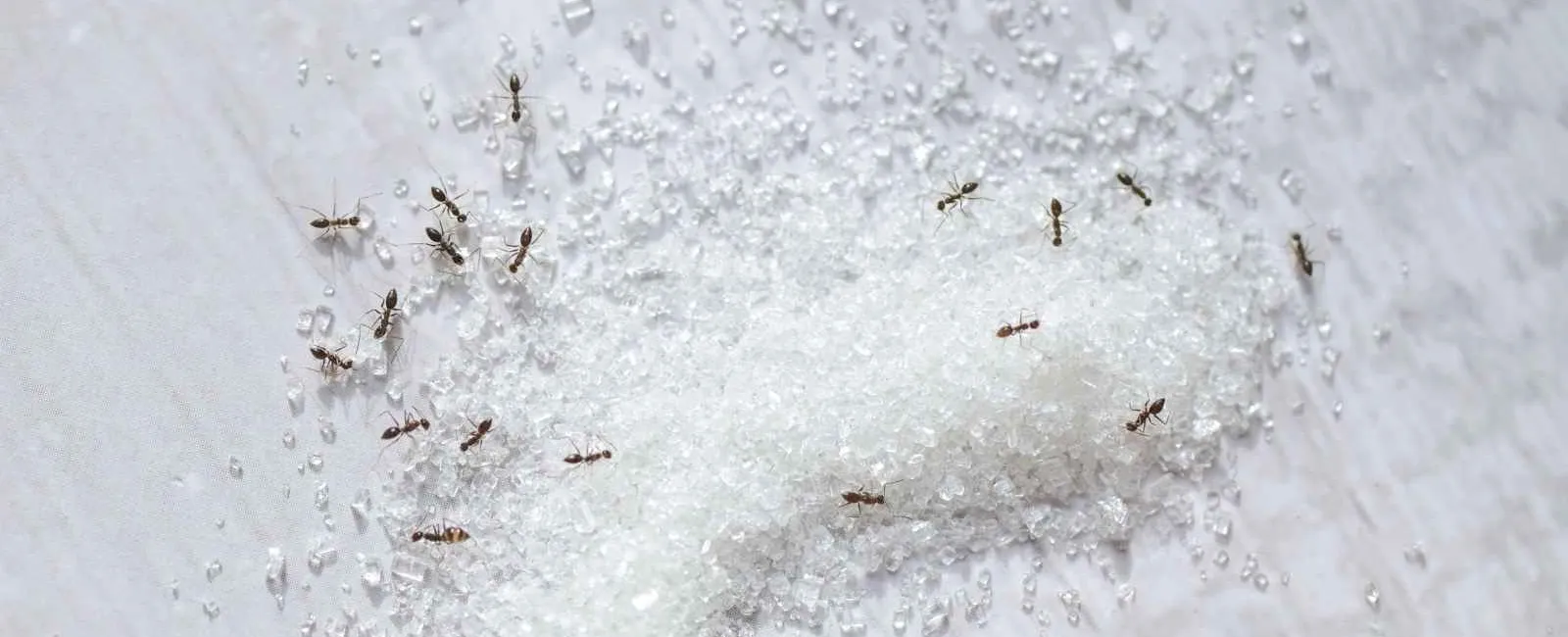
Ghost ants are among the most frequently encountered ant pests in South Florida homes. They are small, fast-moving, and capable of establishing multiple colonies simultaneously across a structure, characteristics that make them significantly more difficult to control than most other ant species.
People also commonly refer to them as sugar ants in Florida, because they are small ants that appear around food, moisture, and sweet substances.
Identification: What Ghost Ants Look Like
Ghost ants are identified by two distinctive features that separate them from other small ant species in South Florida.
Pale abdomen and legs. The worker ants are tiny (approximately 1.3 to 1.5 mm long), with a dark brown head and thorax and a nearly translucent, milky-white abdomen and legs. The pale coloration of the lower body is the source of the common name: the abdomen appears to float independently from the dark head, giving the ant a ghostly appearance under magnification.
Erratic, fast movement. Ghost ants move in rapid, erratic patterns compared to the more deliberate movement of most ant species. When their trail is disturbed, workers scatter quickly rather than regrouping along the original trail.
Coconut odor when crushed. Like odorous house ants, ghost ants release a faint coconut- or musty-like odor when crushed. This is a useful field identification characteristic.
Colony structure. Ghost ant colonies are polygyne; they maintain multiple queens and are polydomous, meaning they spread across multiple nesting sites simultaneously. A single ghost ant infestation in a home may involve several interconnected colonies located in different areas of the structure. This colony structure is one of the primary reasons standard ant control approaches fail against them.
Why South Florida Has Heavy Ghost Ant Pressure
Ghost ants are native to Africa and Asia and were introduced to Florida, where the climate closely matches their preferred tropical environment. They are now well-established throughout the state and are considered one of Florida's most significant structural pest ant species.
Several factors make South Florida residential properties particularly susceptible:
- Year-round breeding without interruption. Ghost ants reproduce continuously in South Florida's climate. There is no winter suppression of colony growth. Populations that establish in a structure in spring will continue growing through fall and into the following year without seasonal natural reduction.
- Moisture-driven foraging. Ghost ants are strongly attracted to moisture. South Florida's humidity, combined with the moisture-rich environments of kitchens, bathrooms, plumbing walls, and exterior landscaping, provides a persistent foraging stimulus. They frequently nest in wall voids near plumbing, in moist potted plant soil, in mulch beds adjacent to the foundation, and inside structures near water sources.
- Outdoor-to-indoor movement. Ghost ants commonly nest outdoors in soil, under mulch, in landscaping debris, and in potted plants, then forage indoors along structural entry points. Any gap around windows, doors, pipes, or electrical conduits serves as a travel corridor. Eliminating indoor activity without addressing the outdoor colony typically results in rapid reinfestation.
- Multiple queen colony structure. Because ghost ant colonies maintain multiple queens across multiple nesting sites, eliminating one nest or one queen has minimal impact on the overall population. New queens can rapidly re-establish colony activity in the treated area.
Where Ghost Ants Are Commonly Found
Ghost ants are found in both indoor and outdoor environments, often simultaneously.
Indoors: Kitchen counters and cabinets near food or moisture, bathroom vanities and under-sink areas, window and door frames, wall voids adjacent to plumbing, around dishwashers and refrigerators, and along baseboards. Ghost ants are attracted to sugary foods, grease, and starchy materials, as well as moisture sources independent of food.
Outdoors: Soil around the foundation, mulch beds pressed against the structure, potted plant soil, under debris and leaf litter, along irrigation lines, and in the root masses of trees and shrubs near the home. Exterior colonies serve as the source population for indoor foragers.
Do Ghost Ants Bite?
Ghost ants can bite, but their mandibles are too small to cause any meaningful sensation in humans. They do not sting. Ghost ants are not medically significant in terms of direct physical harm.
Their primary significance lies in their role as a nuisance pest and a food contaminant. Ghost ants have been documented to infest food packages, contaminate food preparation surfaces, and forage in hospital environments where food contamination and hygiene are critical concerns. They are also associated with damage to indoor plants, where they farm aphids and scale insects for honeydew, as do other ant species.
Why DIY Ghost Ant Treatments Frequently Fail
Ghost ants are consistently rated among the most difficult ant species to eliminate with over-the-counter products. The reasons are specific to their biology and colony structure.
- Repellent sprays cause colony fragmentation. Consumer-grade ant sprays are almost universally repellent-based. When applied to ghost ant trails or around the perimeter, repellent products do not kill the colony. They cause it to split, queens move to new locations, and establish satellite nesting sites in untreated areas. What was one infestation becomes several. This is the most common reason homeowners find that spraying makes the problem worse rather than better.
- Bait selectivity. Ghost ants shift their dietary preferences between protein and carbohydrate phases depending on colony needs and season. A bait that is effective when the colony is in a carbohydrate-seeking phase will be ignored when the colony is seeking protein, and vice versa. Consumer bait stations are formulated with a fixed attractant that may not match the colony's current nutritional phase, resulting in poor bait uptake.
- Multiple nesting sites. Even when bait is accepted and working, treating only one nest location leaves the other interconnected colony sites intact. Ghost ant colonies can recolonize a treated area from an adjacent nest within days.
- Product degradation in South Florida conditions. The heat and UV exposure in South Florida's climate break down active ingredients in retail insecticides faster than label conditions assume, reducing residual effectiveness.
How to Get Rid of Ghost Ants
Effective ghost ant control requires a coordinated approach that addresses the indoor foraging population, the indoor nesting sites, and the outdoor source colonies simultaneously.
Step 1: Identify trails and nesting sites. Before any treatment, trace the ghost ant trails to identify where they originate and where they are entering the structure. Ghost ant trails are typically very fine lines that follow structural edges, baseboards, window frames, plumbing runs, and countertop edges. Identifying the entry points and the direction of travel toward the nest helps determine where treatment will be most effective.
Step 2: Apply non-repellent bait in rotation. Professional ghost ant control uses non-repellent baits in both protein and carbohydrate formulations, placed along active trails and near nesting sites. Non-repellent bait is undetectable to the ants, so workers carry it back into the colony and share it with queens and other workers through trophallaxis (food sharing). This transfer effect is what makes bait-based control far more effective than sprays against multi-queen colonies. Rotating between bait types addresses the colony's dietary shifts across seasons.
Step 3: Non-repellent liquid treatment of interior harborage areas. In addition to bait, a non-repellent liquid treatment applied to known nesting sites, inside wall voids near plumbing, under appliances, and along window frames suppresses the interior population without triggering colony fragmentation.
Step 4: Treat exterior colonies. Granular non-repellent bait applications around the foundation perimeter, in mulch beds, and around any potted plants or landscaping features where ghost ants are nesting outdoors address the source population. Without treating the outdoor colonies, indoor reinfestation continues regardless of how thoroughly the interior is treated.
Step 5: Seal entry points. Caulking gaps around window frames, door frames, pipe penetrations, and electrical conduits reduces the routes ghost ants use to move between outdoor and indoor environments. Exclusion is not a substitute for treatment but makes the treated perimeter more durable.
Our ant control services address ghost ant infestations with professional-grade non-repellent baits and treatments, coordinated between interior and exterior applications.
Preventing Ghost Ant Reinfestation
Ghost ant pressure in South Florida is persistent. Preventing reinfestation after treatment involves managing both attractants and entry conditions.
- Eliminate moisture sources. Fix dripping faucets, address condensation around pipes, keep under-sink areas dry, and remove standing water from drip trays under houseplants. Ghost ants are strongly moisture-driven and will maintain foraging pressure on any consistent moisture source.
- Store food in sealed containers. Open food packaging, uncovered fruit, and residue on countertops attract ghost ant foraging. Sealed glass or hard plastic containers eliminate the food signal that draws scouts indoors.
- Manage exterior landscaping. Pull mulch back at least 6 inches from the foundation. Remove leaf litter and organic debris near the structure. Ensure potted plants near entry points are not serving as exterior nesting sites.
- Maintain a perimeter treatment schedule. Given South Florida's year-round ghost ant activity, quarterly professional perimeter treatment is the most reliable ongoing protection. A single treatment is not sufficient in a region where outdoor colony pressure is continuous.
Ghost Ants vs. Other Common South Florida Ants
Ghost ants are frequently confused with other small ant species in South Florida. Correct identification determines the appropriate treatment.
Ghost ants vs. pharaoh ants. Pharaoh ants (Monomorium pharaonis) are similar in size but uniformly yellow to light orange, without the distinctive pale abdomen of ghost ants. Like ghost ants, pharaoh ants are polygyne and difficult to control with repellents. They are more commonly associated with hospital and institutional environments but do infest residential structures.
Ghost ants vs. white-footed ants. White-footed ants (Technomyrmex difficilis) are black with pale yellow feet and are similar in size to ghost ants. They form large colonies and are notoriously difficult to control. Unlike ghost ants, white-footed ants do not respond well to most baits. They are identified by the distinctive pale foot coloration visible under magnification.
Ghost ants vs. Caribbean crazy ants. Caribbean crazy ants are larger (approximately 1/8 inch), reddish-brown throughout with no pale sections. They move in the erratic, directionless patterns described in their common name. They are a separate species requiring entirely different treatment.
If you are uncertain which species you are dealing with, contact us for an identification before purchasing or applying any product.
Scheduling a Ghost Ant Inspection
Ghost ant infestations that have been present for more than a few weeks typically involve multiple nesting sites and established outdoor colonies. A professional inspection identifies the extent of the infestation and determines where treatment needs to be applied for results to last.
Royal Pest & Termite is locally owned, based in Miramar, and has been treating South Florida ant infestations since 2014. Our ant control services and general pest control programs are built for the specific ant species and conditions in this region.
Call us at (754) 202-4605 or schedule a free inspection online.
We serve Miramar, Pembroke Pines, Davie, Hollywood, Fort Lauderdale, Boca Raton, South Palm Beach County, and most of Broward County, FL. We also service select areas in northern Miami-Dade County. Call us to confirm availability at your address.