Why Size On Its Own Misleads
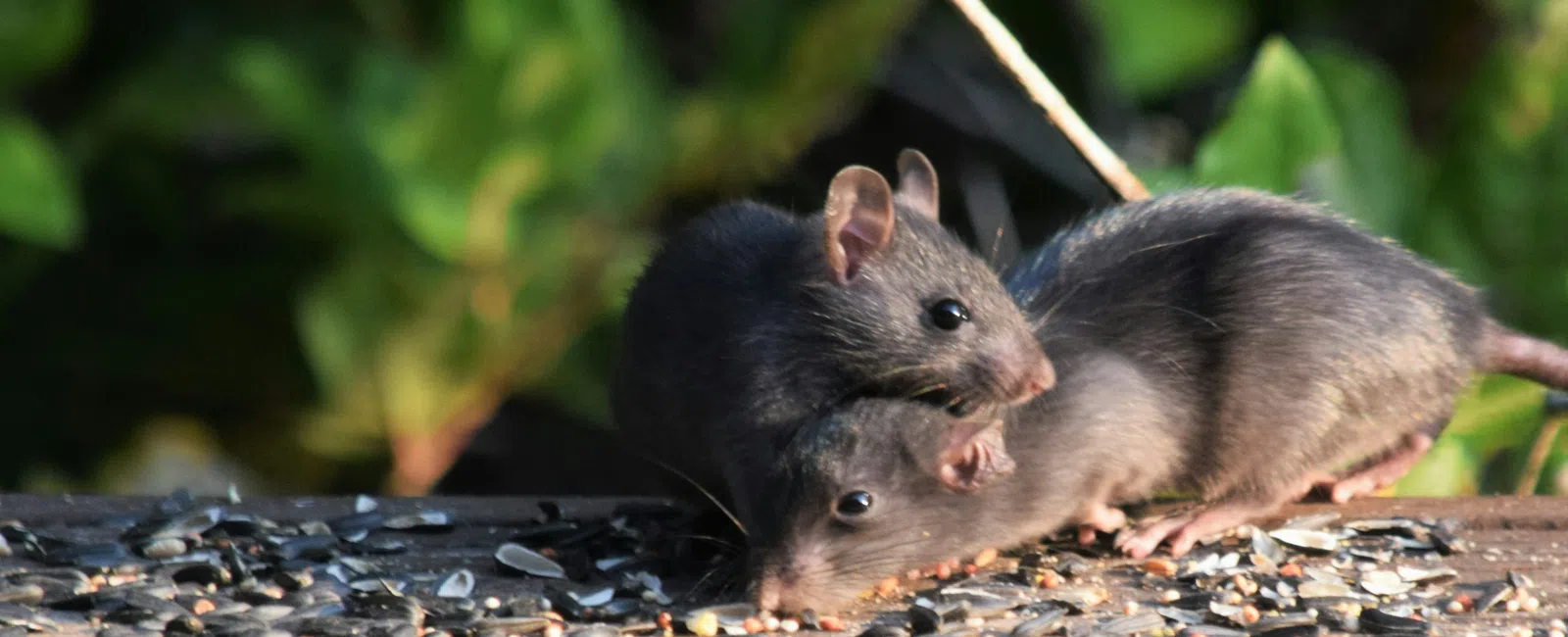
A full-grown house mouse weighs around half an ounce. A roof rat, which dominates South Florida, weighs anywhere from half a pound to a pound. That gap is impossible to miss.
In a hallway at eleven at night, it is very easy to miss. Mice mature sexually at about six weeks, while rats take three to five months to get there, so a rat spends a long adolescence at a weight that overlaps an adult mouse. The animal you saw may well have been a rat that simply is not finished growing.
The Proportion Test
Stop comparing the animal to other animals and start comparing its parts to each other.
| What to Look At | House Mouse | Roof Rat |
|---|---|---|
| Weight | About half an ounce | Half a pound to a pound |
| Tail | About as long as the body | Longer than the head and body combined |
| Ears | Large compared to a small head | Present but modest against a much heavier head |
| Coat | Brown to gray | Black through grizzled gray to tan, with a lighter belly |
| Droppings | Around one eighth of an inch, rod shaped | Up to half an inch, spindle shaped with pointed ends |
A mouse reads as delicate. Small head, thin tail in proportion, ears that look slightly too big for it. A rat reads as heavy even when it is small, because the head and feet develop ahead of the body. If what you saw looked top-heavy or clumsy, that is a point toward a rat.
South Florida has a second rat species, the Norway rat, which is stockier with a blunt muzzle and a tail only about as long as its head and body. It is far less common here than the roof rat, and most homeowners in Miami-Dade, Broward, and Palm Beach counties will need the roof rat identification markers.
Droppings Settle It Better Than A Sighting
You will see droppings long before you get a clean look at the animal, and they hold up better as evidence. A mouse leaves droppings about one-eighth of an inch long, rod-shaped, and scattered casually wherever it has been feeding, which means inside drawers, in the backs of cabinets, along the tops of pantry shelves. Roof rat droppings run up to half an inch, come to a point at the ends, and cluster along the routes the animal uses rather than appearing everywhere.
Norway rats leave something different again: droppings closer to three-quarters of an inch with blunt, capsule-like ends, usually near ground level.
The pattern matters as much as the shape. Scattered and small points to mice. Concentrated, larger, and overhead points to rats in the attic or roofline.
The Hole Tells You Too
Mice and rats do not need the same opening. A mouse can get through a gap about a quarter inch wide. A rat needs roughly half an inch. That difference has a practical consequence people rarely anticipate: a house sealed competently against rats is still open to mice. Quarter-inch gaps are easy to overlook around utility penetrations, door sweeps, and weep holes, and they are enough.
How Far They Travel Is The Difference That Matters Most
This is the one that changes the shape of the problem. A house mouse spends its life within roughly 10 to 30 feet of its nest. Rats range 100 to 150 feet.
Think about what that means for where the animal actually lives. Droppings in a pantry mean a mouse is nesting inside the structure, within about 30 feet, probably behind a wall or in the back of a cabinet or inside a piece of furniture. Droppings in an attic can mean a roof rat that nests off the ground in a palm or in ornamental shrubbery, possibly on a neighboring property, and comes into the house on a nightly commute along a branch or a utility line.
Same evidence, two completely different jobs. One is contained in the building. The other is a property-line problem where the harborage is outside and may not belong to you.
Why The Species Changes What Happens Next
Behavior diverges in ways that show up immediately once control work starts. Mice are curious and will normally investigate a new trap on the first night. Roof rats are wary of unfamiliar objects and may take a week before they go near one. A homeowner who sets traps, sees nothing happen for three days, and concludes the traps are not working has learned something different depending on which animal is in the house. With mice, silence after three nights is meaningful. With rats, it is normal.
Feeding habits separate them as well. A mouse needs only about a tenth of an ounce of food and a twentieth of an ounce of water per day. A kitchen can be genuinely clean and still supply a mouse population indefinitely, which is why sanitation alone rarely resolves a mouse problem. Rats need closer to an ounce of food and an ounce of water daily, so they depend on a more substantial source, often fruit trees, pet food, or garbage held outside.
Getting the species right before anything else happens is the part worth paying attention to, and it is harder from inside the house than it sounds. Whether droppings in an attic belong to a resident population or a commuting one, whether a juvenile animal means a litter nearby, and which of several quarter-inch and half-inch gaps is actually in use are all questions that an inspection answers rather than an inference. Rodent control built on the wrong species puts traps in the wrong places and seals the wrong openings, and the activity continues. Homeowners who want to start by working through what they are seeing can begin with the broader signs of a rodent infestation.
At Royal Pest & Termite, every product we use in an attic, a kitchen, or along a foundation is chosen to handle rodents while staying safe for kids and pets, the same standard that has kept us at 4.8 stars across 173 Google reviews. We are licensed, insured, and a member of the Florida Pest Management Association, and we offer free inspections and estimates across our South Florida service areas in Miami-Dade, Broward, and Palm Beach counties, backed by a guarantee with free call-backs between scheduled visits.
Call us today to schedule a free rodent inspection and identify what is in your walls before cooler weather pushes more of them indoors.