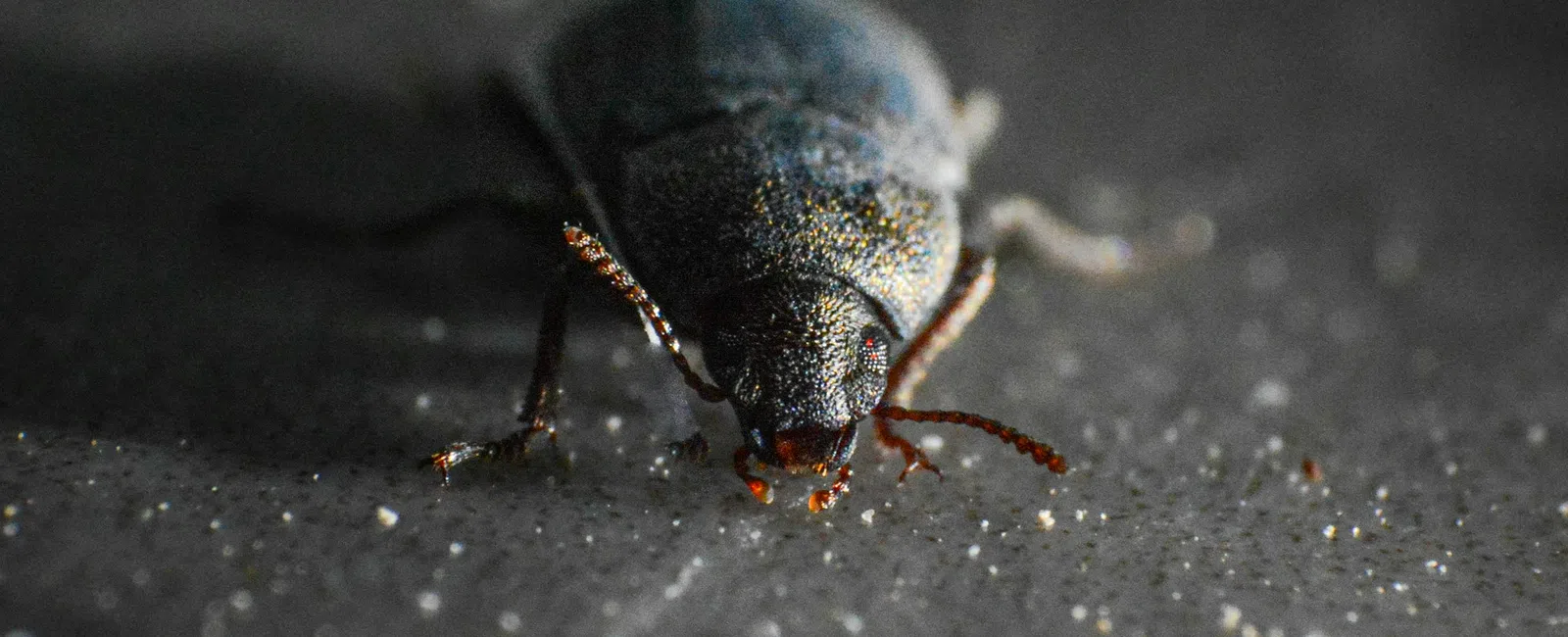
What Carpet Beetles Look Like
Adult carpet beetles are small and rounded, roughly the size of a pinhead, with a hard shell. Some are solid black, and the black carpet beetle is one of the most common indoors. Others, like the varied carpet beetle, have a mottled pattern of brown, white, and yellow scales. Adults are harmless and often show up near windows because they feed on pollen and are drawn to light.
The damage comes from the larvae, not the adults. A carpet beetle larva is small and fuzzy, covered in bristly hairs, and it tends to hide in dark, undisturbed spots. Carpet beetle eggs are laid near a food source, which for these insects means natural fibers. The larvae feed on wool, silk, leather, feathers, pet hair, and dried goods, and they leave small irregular holes in clothing, rugs, and upholstery along with shed skins that look like tiny hollow casings.
What Bed Bugs Look Like
Bed bugs are flat, oval, and reddish brown, and a full-grown adult is about a quarter inch long, close to the size of an apple seed. After a blood meal, they look swollen and darker. Young bed bugs, called nymphs, are smaller and paler, sometimes almost translucent until they feed. Bed bug eggs are white, about the size of a pinhead, and usually tucked into seams and cracks in clusters.
Unlike carpet beetles, bed bugs have no interest in your carpet or your wool sweaters. They feed on blood, which is why they stay close to where people sleep or sit for long stretches. A careful bed bug inspection covers the mattress seams, box spring, headboard, and cracks in nearby furniture, the hiding spots most people overlook.
Do Carpet Beetles Bite?
Carpet beetles do not bite, and they do not feed on blood. What people describe as carpet beetle bites is usually a reaction to the tiny hairs on the larvae. In some people, those bristles trigger an allergic response that shows up as an itchy red rash or raised welts, which is easy to mistake for an insect bite. That carpet beetle rash tends to appear where skin touched an infested item, like bedding, a rug, or stored clothing, rather than in a clear bite pattern.
Because it is an allergic reaction and not a bite, the marks often keep coming back until the source is cleaned out. If you treat the skin but never find the larvae, the rash returns.
What Bed Bug Bites Look Like
Bed bug bites are real bites, and they usually show up as small, itchy, raised welts on skin that was exposed while you slept, such as the arms, shoulders, neck, and legs. A common clue is the pattern, since bed bug bites often appear in a line or a small cluster where the bug fed more than once.
People frequently compare bed bug bites to other pests. Flea bites tend to hit the lower legs and ankles and have a red dot in the center, and the differences between flea and bed bug bites come down to location and pattern. Mosquito bites are usually larger, puffier, and more random. On their own, bites are not proof, since reactions vary from person to person and some people show no marks at all, so it helps to look for physical signs in the room.
Signs Beyond the Bugs
The evidence each pest leaves behind is one of the clearest ways to tell them apart. Bed bugs leave rusty or dark brown fecal spots, sometimes called bed bug droppings, on sheets, mattress seams, and nearby walls. You may also see small blood smears on the sheets and pale shed shells, the exoskeletons bed bugs leave as they grow. A heavy infestation can carry a musty, sweet odor.
Carpet beetles leave a different trail. Instead of fecal spotting on bedding, they leave shed larval skins near baseboards, in closets, and inside stored fabrics, along with the fiber damage itself. If you are finding thin, bristly cast skins and holes in wool or silk, that points to carpet beetles. If you are finding dark spotting and shells around the mattress, that points to bed bugs.
Other Bugs That Look Like Bed Bugs
Carpet beetles are not the only bed bug look-alikes. Bat bugs are close relatives that look nearly identical to the naked eye and usually mean bats or birds are roosting nearby. Immature cockroaches, or baby cockroaches, are reddish brown and get mistaken for bed bugs, though they move much faster. Ticks, spider beetles, and fleas round out the list of insects that send people searching for answers. The takeaway is that finding one small brown bug is rarely enough to confirm bed bugs, and a proper inspection settles it.
How to Tell Which One You Have
Location is the fastest tell. Bed bugs cluster within a few feet of where you sleep, so check the mattress seams, box spring, headboard, and the cracks in nearby furniture. Carpet beetles spread out toward carpets, closet floors, windowsills, air vents, and anywhere natural fibers sit undisturbed. If the activity centers on the bed, lean toward bed bugs. If it centers on rugs, closets, and stored clothing, lean toward carpet beetles.
The type of harm helps too. Holes in wool, silk, and leather point to carpet beetles feeding on the fabric. Itchy welts in a line with dark spotting on the sheets point to bed bugs feeding on you. The table below sums up the differences side by side.
What to Check |
Carpet Beetle |
Bed Bug |
|---|---|---|
Size & Shape |
Tiny and round, about 1/16 to 1/8 inch, hard shell |
Flat and oval, about 1/4 inch, apple-seed size |
Color |
Black, or mottled brown, white, and yellow |
Reddish brown, darker after feeding |
Do they bite you? |
No, they do not bite or feed on blood |
Yes, they feed on blood while you sleep |
Where you Find Them |
Carpets, closets, windowsills, stored wool and fabric |
Mattress seams, box springs, headboards, furniture cracks |
Signs they Leave |
Shed larval skins and holes in fabric |
Rusty fecal spots, blood stains, shed shells |
How to Get Rid of Them in South Florida
The two pests call for different treatment, which is exactly why identifying the bug first matters. Carpet beetles usually respond to thorough cleaning, vacuuming, laundering or discarding infested fabrics, and a targeted treatment of the areas where larvae hide.
Bed bugs are a tougher problem. They hide deep in seams and cracks, their eggs resist many over-the-counter sprays, and a single missed pocket can restart the infestation. Store-bought foggers often scatter them into new areas rather than solving the problem. Professional bed bug treatment in South Florida reaches the places DIY methods miss, and the region's warm climate and heavy travel through Miami keep bed bugs moving between homes, hotels, and rentals year-round.
When to Call Royal Pest & Termite
If you are not sure which pest you have, or the bites and rashes keep coming back, a professional inspection ends the guessing. Royal Pest & Termite serves Miami-Dade, Broward, and Palm Beach counties, and every treatment uses pet-safe pest control products chosen to protect children and animals, the promise the company was built on.
Royal Pest & Termite is licensed and insured, a proud member of the Florida Pest Management Association, and rated 4.8 stars across 173 Google reviews. Inspections and estimates are free, and the work is backed by a guarantee with free call-backs between scheduled visits. Call today to book a free inspection.