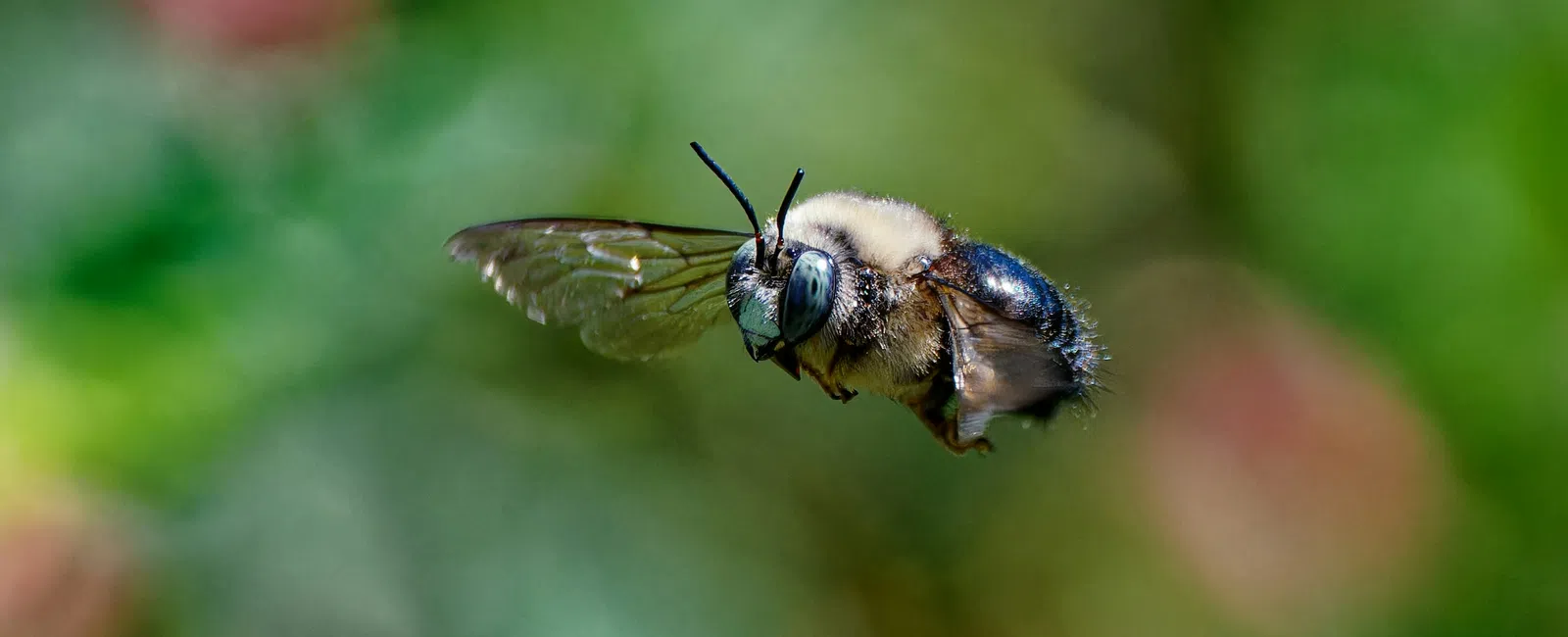
What Carpenter Bees Look Like
Carpenter bees are among the largest bees you will see in Florida, usually close to an inch long. They have a shiny, mostly hairless black abdomen that often looks almost metallic in the sun. Florida is home to large carpenter bees in the genus Xylocopa, and once you know what to look for, they are hard to miss around a house.
Males and females look a little different. Female carpenter bees are the ones that bore into wood, and they have an all-black head. Males frequently have a pale yellow or white patch on the face, and they are the bees you see hovering and chasing anything that comes near the nest. That hovering behavior looks aggressive, but as the sting section below explains, the males doing it cannot actually sting you.
Carpenter Bee vs. Bumble Bee
People mix up carpenter bees and bumble bees constantly, and the difference comes down to the abdomen. A bumble bee has a fuzzy, hairy abdomen with yellow markings. A carpenter bee has a smooth, shiny black abdomen with little to no hair. If the back half of the bee looks bald and glossy, you are looking at a carpenter bee. Bumble bees also nest in the ground or in existing cavities, while carpenter bees drill their own tunnels into wood, so nesting behavior can give them away too.
Do Carpenter Bees Sting?
Male carpenter bees have no stinger at all. They are the ones hovering aggressively around porches and decks, so the bee acting the most territorial is the one that physically cannot hurt you. Female carpenter bees do have a stinger, but they are not aggressive and rarely sting unless you grab one or trap it against your skin.
Carpenter bees do not bite people in any meaningful way either, and they are not dangerous to the average person. The exception is anyone with a known bee sting allergy, who should treat a female carpenter bee with the same care as any other stinging insect. The same caution that helps with wasps and hornets applies here, and a few habits for avoiding insect stings at home lower the odds of a reaction when bees are active in the yard.
The Damage Carpenter Bees Do to Wood
The sting is not the real concern with carpenter bees. The wood damage is. A female chews a nearly perfect round entry hole about half an inch wide, then tunnels along the grain to create galleries where she lays her eggs. A single hole looks minor, but carpenter bees reuse and extend the same tunnels year after year, and a board can end up with a network of galleries running several inches or even feet inside it.
You will often spot the problem before you see the bee. Look for round holes in bare wood, coarse sawdust on the ground below, and yellowish staining from droppings streaking down from the entry. Woodpeckers make it worse in some yards by tearing into the wood to reach the larvae, which turns a neat hole into a ragged gash. Because the damage builds slowly, many South Florida homeowners do not notice until a railing feels loose or a fascia board starts to sag.
Carpenter bees are one of several pests that quietly chew through the wood on a house, and it helps to know what you are dealing with. Telling carpenter ants from termites matters for the same reason, because each wood pest calls for a different treatment and the wrong fix wastes time and money.
Where Carpenter Bees Nest Around South Florida Homes
Most South Florida homes are concrete block, which is part of why carpenter bees get overlooked here. The bees cannot touch masonry, so they concentrate on the wood features that almost every property still has. Common targets include deck boards and railings, wooden fence posts, pergolas and patio covers, fascia boards and soffits under the roofline, window and door trim, wooden play sets, and the pilings and framing on docks.
Carpenter bees strongly prefer bare, weathered, or unfinished softwood such as pine, cedar, and cypress. Fresh, painted, or well-sealed wood is far less attractive to them, which is a useful clue for both spotting risk and preventing it. If you have a natural-finish deck or an aging fence that has not been sealed in years, those are the first places to check.
Carpenter Bee Season and Life Cycle
Carpenter bees become most visible in spring, when adults emerge to mate, and the females start drilling or reopening nests. In the warm South Florida climate, that activity stretches across a longer window than it does up north, and you may see bees around the house well beyond the typical spring peak. Adults that overwinter tuck into old galleries and come back out when temperatures rise.
There is generally one generation per year. Eggs laid in spring develop through summer, new adults emerge in late summer, and they overwinter to start the cycle again. Individual adult carpenter bees live roughly a year. That yearly return is exactly why a nest you ignore this season tends to be a bigger nest next season.
Are Carpenter Bees Pollinators?
Yes, and this is worth keeping in mind before you reach for a can of spray. Carpenter bees are native pollinators, and they use a technique called buzz pollination that helps many flowering plants, including some garden vegetables. They do sometimes cut into the base of a flower to steal nectar without pollinating, but on balance they are beneficial insects.
That is why responsible control aims to protect your wood and treat active nests rather than wipe out every bee in the neighborhood. Targeted treatment solves the structural problem while leaving the broader pollinator population in better shape.
How to Get Rid of Carpenter Bees
Getting rid of carpenter bees works best when you combine treating the existing nests with making the wood less appealing. A few approaches homeowners use:
- Seal and finish exposed wood. Painting or applying a quality sealer or varnish to bare decks, fences, and trim makes the surface much less inviting for new tunneling.
- Plug old holes at the right time. After a gallery is no longer active, filling the hole with wood putty or a wood dowel and then painting over it keeps that tunnel from being reused next year.
- Set carpenter bee traps. Hung near active areas, these traps catch bees drawn to existing holes and can take pressure off a hard-hit deck or fence.
- Swap in bee-resistant materials. When you replace a rotted fence post or railing, hardwoods and composite or vinyl materials give the bees nothing to drill into.
Do-it-yourself steps help, but they have limits. Active galleries usually need to be treated at the source; nests are often high on fascia or roofline trim where a ladder and stings come into play, and store-bought sprays can be harsh to use around kids, pets, and the plants you want to keep. That is where professional treatment earns its keep.
How to Keep Carpenter Bees Away
Prevention comes down to denying them the bare softwood they look for. Keep decks, fences, railings, and trim painted or sealed, repair weathered boards before they turn silvery and soft, and give exposed wood a fresh finish on a regular schedule. Inspect the sunny sides of the house each spring, since carpenter bees often favor south- and east-facing wood that warms early in the day. Staying ahead of the finish on your wood is the single most effective way to keep carpenter bees away year after year.
When to Call a Professional in South Florida
If you are seeing round holes, sawdust piles, or bees returning to the same deck or fascia every spring, a professional inspection can determine how far the galleries run and treat them without putting your family or pets at risk. Royal Pest & Termite offers bee control across Miami-Dade, Broward, and Palm Beach counties, and every treatment uses pet-safe pest control products chosen to protect children and animals, the promise the company was built on.
Royal Pest & Termite is licensed and insured, a proud member of the Florida Pest Management Association, and rated 4.8 stars across 173 Google reviews. Inspections and estimates are free, and service is backed by a guarantee with free call-backs, so if the bees come back between visits, so do we. Call us today to schedule a free carpenter bee inspection.