The Quick Version
Look at size first, then look at the shield behind the head.
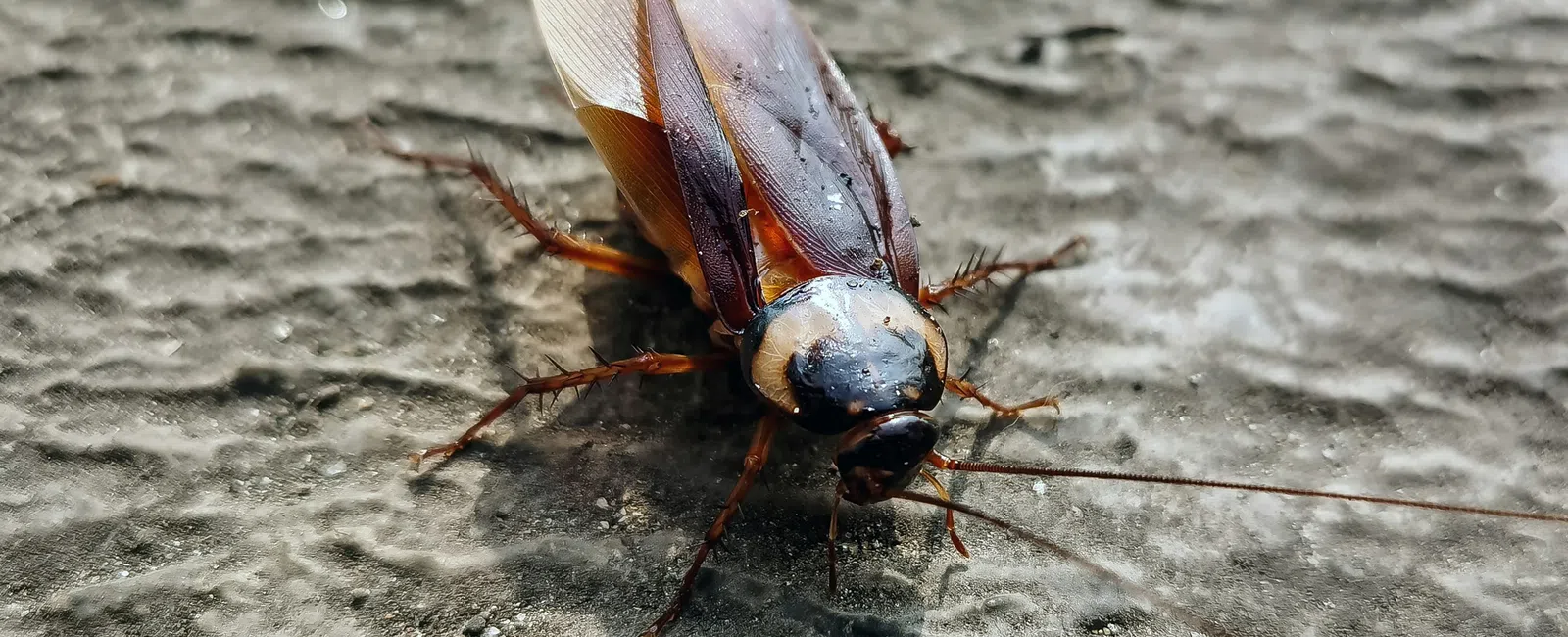
- Small, roughly half an inch, light tan or brown, with two dark parallel stripes running down that shield: German cockroach.
- Big, an inch and a half or longer, reddish brown, with a pale yellow band ringing that shield: American cockroach.
Size alone gets you most of the way there. A German cockroach fits comfortably on a quarter. An American cockroach does not fit on a business card.
German Cockroach vs. American Cockroach Size And Markings
Adult German cockroaches run about half an inch long, roughly 10 to 15 millimeters. They are tan to brown with two dark bands on the pronotum, the plate that covers the head. Nymphs are smaller and darker, often nearly black with a lighter stripe down the back, and people frequently mistake them for beetles.
The American cockroach averages 1.5 inches and is the largest roach that regularly turns up in Florida homes. It is reddish-brown with a pale brown or yellow border around the edge of the pronotum. Adults have full wings and can glide, which is how one ends up on your shoulder from the ceiling.
Color helps, but the stripes are the real tell. Two dark racing stripes mean German. A yellow outline means American.
Bugs That Look Like Cockroaches
If you grew up in Florida, you probably call the big ones palmetto bugs. That nickname causes more confusion than anything else in roach identification, because it describes a size and a place, not a species. Around here, a palmetto bug is almost always an American cockroach, though the label also gets attached to the Florida woods cockroach and the smoky-brown cockroach.
What those three have in common is where they live: outside, in mulch beds, palm fronds, and hollow trees. A German cockroach is never a palmetto bug. It is too small, it has the wrong markings, and it does not live in your landscaping.
Where Do Cockroaches Come From?
This is where the two species split completely, and it matters most for getting rid of them.
German cockroaches do not live outdoors in any meaningful way. They need human buildings to survive, and they almost never crawl in under a door.
Instead, they hitchhike. They ride in on grocery bags, cardboard boxes, secondhand appliances, used furniture, luggage, and delivery cartons. In condos and apartments, they also travel between units through shared plumbing walls, which is why a neighbor's problem can quietly become yours. Once inside, they settle within a few feet of food and moisture, usually behind the refrigerator, under the sink, or in the seams of kitchen cabinets.
American cockroaches are outdoor insects that come inside by accident or in search of water. Their habitats usually include sewers, drainage systems, hollow trees, wood piles, and mulch. In our climate, that also means storm drains, irrigation boxes, palm trees, dumpster pads, and the damp mulch bed against your foundation.
They get in through floor drains, sink overflows, weep holes, garage door gaps, and unsealed pipe penetrations. Heavy summer rain drives them indoors in waves, which is one reason sightings spike in July and August across Miami-Dade, Broward, and Palm Beach counties.
Which One Is An Actual Infestation?
Both are worth acting on, but the math differs a lot.
A female American cockroach produces roughly one egg case a month for about ten months, with 16 eggs in each, and development from egg to adult takes close to 600 days. That is slow. Seeing one or two a week usually means they are breeding outside and wandering in, not nesting in your walls.
A German cockroach carries an egg case holding 30 to 40 eggs, and the full cycle from egg to adult runs about 100 days. Females breed continuously. Do the math on a few of them, and you get an interior population that grows faster than most people expect. German cockroaches also spread bacteria across food surfaces and shed skins and droppings that trigger asthma symptoms, so they are the more serious health concern of the two.
German cockroaches also stay hidden during the day, so if you are seeing small tan roaches in daylight, the harborage is already crowded.
Why Treatment Is Different For Each One
Treating an American cockroach problem is mostly an outside job. A technician works the perimeter, treats harborage in mulch and around utility boxes, addresses drains and weep holes, and seals the entry points they use. Trimming vegetation off the house and fixing standing water does a lot of the work. Ongoing cockroach control service keeps that barrier intact through the rainy season.
German cockroaches are the opposite. Perimeter spraying does close to nothing, because the population lives entirely indoors. Effective German cockroach treatment targets harborage directly inside cabinet voids, appliance motors, and hinge gaps, paired with sanitation and follow-up visits timed to catch nymphs hatching from egg cases that survived the first round. Over-the-counter sprays often make things worse by scattering the population into new voids. Anyone dealing with a German cockroach infestation should plan on a treatment sequence rather than a single visit.
Prevention overlaps for both species. Fix leaks, store food in sealed containers, break down cardboard quickly, and take a few steps to keep cockroaches out before the next round of summer rain.
Seeing Roaches In Your South Florida Home?
Identification changes the plan, so it is worth having someone confirm what you have before you spend money on the wrong approach. Royal Pest & Termite serves Miami-Dade, Broward, and Palm Beach counties from our Miramar office, using products chosen to be safe around kids and pets. We are licensed, insured, a proud member of the Florida Pest Management Association, and rated 4.8 stars across 173 Google reviews.
Call today for a free inspection and estimate. If roaches return between scheduled visits, we come back and re-treat at no charge.