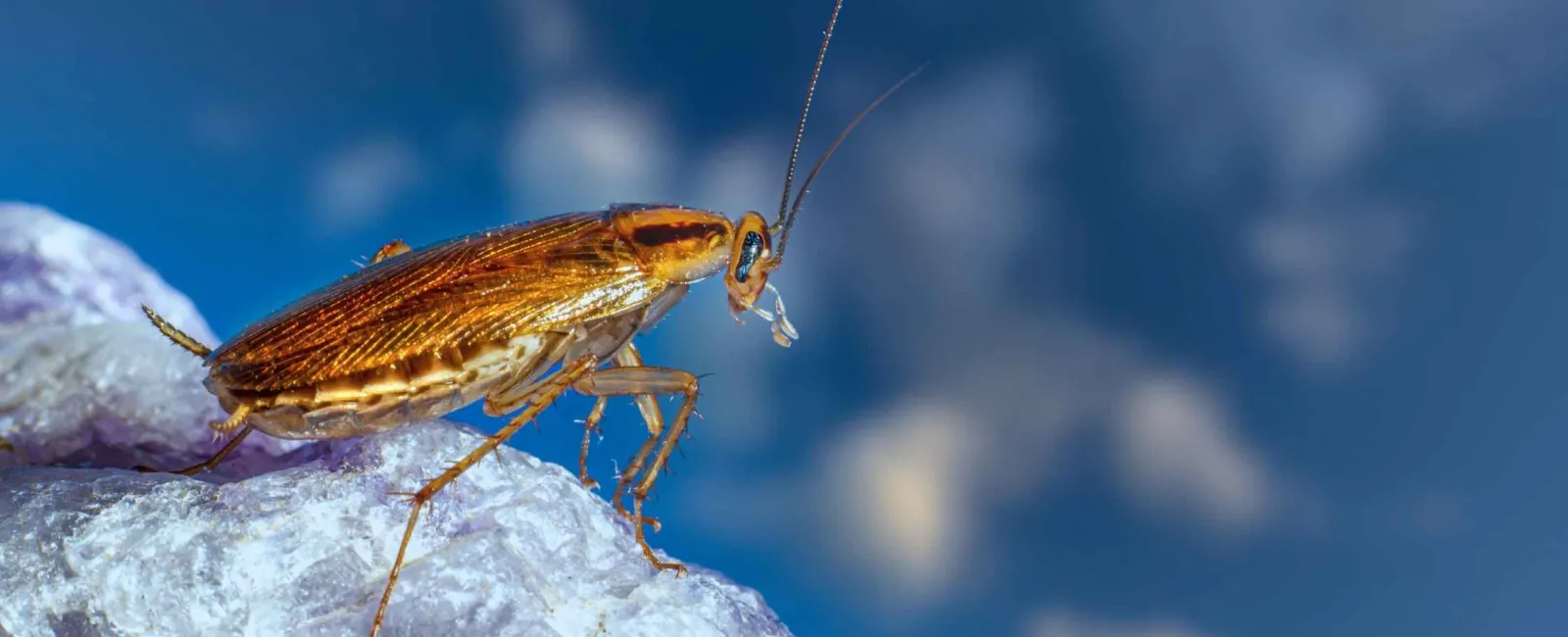
Palmetto bugs are among the most common pest complaints in South Florida and among the most misunderstood. Homeowners want to know whether they're dangerous, whether a single sighting indicates a larger problem, and why standard over-the-counter products don't seem to work on them.
Is a Palmetto Bug a Cockroach?
Yes. A palmetto bug is a cockroach. Specifically, it's almost always the American cockroach (Periplaneta americana), the largest of the common cockroach species and the one that terrifies South Florida homeowners most reliably.
"Palmetto bug" is a regional nickname used throughout the Southeast, especially Florida and the Carolinas. The name comes from the palmetto palm trees these cockroaches favor as outdoor habitat. Calling them palmetto bugs is a bit like calling a mountain lion a "Florida panther"; it's a local name for a species that exists everywhere, just concentrated here.
There's also a second species that sometimes gets the palmetto bug label in Florida: the Florida woods cockroach (Eurycotia floridana), a shorter, darker, wingless species that releases a foul odor when threatened. It's less common indoors but does show up in garages, mulch beds, and around the perimeter of homes.
When most South Florida homeowners say "palmetto bug," they mean the American cockroach: the big, reddish-brown, fast-moving one that flies occasionally and shows up in the bathroom at 2 a.m.
Why Does South Florida Have So Many Palmetto Bugs?
American cockroaches are tropical insects. They thrive in warm, humid environments and breed continuously when conditions support it. South Florida's year-round heat and humidity sustain population densities that are genuinely higher than most of the country.
Several factors specific to this region compound the pressure:
The sewer and drainage system. American cockroaches are closely associated with municipal sewer systems, storm drains, and utility lines. South Florida's extensive drainage canal infrastructure and underground pipe network create a vast, warm, moist habitat that sustains massive outdoor cockroach populations. These are the bugs that migrate into your home from outside when conditions change.
Mature landscaping. Palmetto bugs shelter in leaf litter, mulch beds, hollow trees, and dense ground cover, all of which are abundant in South Florida's lush residential landscaping. A thick mulch bed against your foundation is essentially a palmetto bug hotel.
Year-round breeding. In northern states, cockroach populations experience natural winter suppression. In Broward, Miami-Dade, and Palm Beach Counties, there is no such seasonal reset. Populations breed continuously throughout the year.
Construction styles. Many South Florida homes have slab-on-grade construction, stucco exteriors, and aging pipe penetrations that provide direct entry routes from the ground into the structure.
Should I Be Worried If I See One Palmetto Bug?
The answer depends on where and when you see it.
One palmetto bug in the kitchen at night doesn't necessarily mean you have an infestation. American cockroaches primarily live outdoors in South Florida. A single bug may have wandered in through a gap under a door, through a utility penetration, or through an open window. In Florida, this is genuinely common; outdoor populations are enormous, and the occasional stray is almost unavoidable.
What makes it a problem: Seeing multiple palmetto bugs, seeing them during the day, finding them in multiple rooms, or seeing smaller cockroaches alongside them. American cockroaches tend to be solitary scouts; large German cockroaches, by contrast, are almost always a sign of an indoor infestation. If you're finding small, dark cockroaches in addition to the big ones, that's a more serious situation requiring immediate professional attention.
Where you see them matters too. One palmetto bug in the garage is different from one in a bedroom closet or inside a kitchen cabinet. The further into your home they're appearing, the more likely there's an entry point or condition attracting them rather than just a single wandering individual.
The rule of thumb: one palmetto bug in an exterior room at night is probably a stray. Multiple sightings in interior rooms or during the day warrant a call.
Does One Palmetto Bug Mean an Infestation?
Not necessarily, but it's worth taking seriously. A single American cockroach doesn't confirm an infestation the way a single German cockroach does. German cockroaches almost never appear unless there's a colony nearby. American cockroaches roam more independently.
That said, if one came in, others can. The question is whether there's an attractant or an entry point that consistently brings them in. A one-time sighting with no repeats is probably nothing. Recurring sightings over several nights suggest an entry point that needs to be found and sealed, and likely a treatment that needs to be applied at the perimeter.
South Florida's outdoor palmetto bug population is enormous and persistent. The goal isn't to eliminate every cockroach in your neighborhood. The goal is to make your home inhospitable and inaccessible to them.
Do Palmetto Bugs Fly?
American cockroaches have fully developed wings and can fly, especially in warm weather. They don't fly frequently or with great control, but when startled or when temperatures are high, they will take short flights. In South Florida's summer heat, this behavior is more common than homeowners expect.
Flight is typically triggered by a disturbance rather than navigation. They're not heading toward you deliberately, but the direction is often unpredictable.
What Instantly Kills Palmetto Bugs?
Professional non-repellent perimeter treatments are more effective because they work through the transfer effect rather than on contact. Cockroaches walk through the treated zone, pick up the active ingredient, and carry it back toward nesting areas. This addresses the population rather than individual insects.
- Non-repellent perimeter treatments. Applied around the exterior foundation, entry points, and utility penetrations. Because the product is undetectable to cockroaches, they walk through it rather than avoiding it.
- Interior baits for German cockroaches. If smaller cockroaches are also present, gel baits placed in precise locations address the indoor colony through the transfer effect: cockroaches consume the bait and share it with the colony.
- Entry point identification and sealing. Door sweeps, pipe penetrations, utility line entry points, and cracks in the foundation are how cockroaches get in. Treatment without exclusion is a temporary fix.
Contact sprays like consumer aerosols kill on contact but function as repellents. Applied around entry points, they push cockroaches toward alternative routes rather than eliminating them. In South Florida's high-pressure outdoor environment, this creates a cycle of recurring sightings that does not resolve the underlying pressure.
How to Get Rid of Palmetto Bugs in Your South Florida Home
Getting palmetto bugs under control requires addressing three things simultaneously: reducing outdoor pressure, closing entry points, and treating with non-repellent products.
- Reduce outdoor harborage. Pull mulch back at least 6 inches from your foundation. Trim vegetation away from the sides of your house. Remove any wood piles, debris, or organic material stored against the structure. These all serve as outdoor sheltering zones that put cockroaches directly in contact with your home.
- Seal entry points. Check the sweep under every exterior door; if you can see light, a palmetto bug can get in. Check where utility lines, pipes, and conduits enter the foundation. Caulk visible gaps in stucco or exterior walls.
- Fix moisture issues. American cockroaches are strongly attracted to moisture. Leaky outdoor faucets, irrigation heads that spray against the foundation, and poor drainage around the perimeter all draw them in. A dry foundation perimeter is a significant deterrent.
- Professional perimeter treatment. For South Florida's outdoor palmetto bug pressure, DIY products don't maintain adequate residual in our heat and UV conditions. Professional-grade non-repellent perimeter treatments, reapplied quarterly, are the most effective way to maintain control against a pest that's constantly pressuring your home from the outside.
Our cockroach control services and general pest control programs address the full picture: outdoor perimeter treatment, entry point assessment, and targeted interior treatment when needed.
Palmetto Bug vs. German Cockroach
The two species require completely different treatment approaches. Misidentifying them is one of the most common reasons DIY cockroach control fails.
Palmetto bugs (American cockroaches):
- Large (1.5 to 2 inches)
- Reddish-brown with a yellowish figure-8 pattern behind the head
- Live primarily outdoors, enter homes opportunistically
- Usually solitary when seen indoors
- Wings present, capable of flight
- Treatment focus: perimeter and exclusion
German cockroaches:
- Small (0.5 to 0.6 inches)
- Light brown with two dark stripes behind the head
- Live primarily indoors, rarely found outside
- Almost always indicates an indoor infestation when seen
- Wings present but rarely fly
- Treatment focus: interior baits, IGRs, targeted application
If you're seeing small cockroaches inside your home alongside the big palmetto bugs, the small ones are the more urgent problem. German cockroach treatment requires a completely different approach from palmetto bug perimeter control, and mixing them up is one of the most common DIY treatment mistakes we see.
How Royal Pest & Termite Approaches Palmetto Bug Control
Palmetto bug pressure in South Florida requires a treatment strategy calibrated specifically for this region. The outdoor population density, year-round breeding cycle, drainage infrastructure, and construction styles of Broward County and Miami-Dade homes all affect how treatment needs to be structured and how frequently it needs to be reapplied.
National pest control companies apply the same protocols here that they use in Ohio. Royal Pest & Termite has been based in Miramar and treating South Florida homes since 2014. We know the specific entry pressure patterns in canal-adjacent neighborhoods, how South Florida's UV and humidity affect product residual times, and the seasonal behavior shifts that occur even in our mild winters.
We never subcontract. When you call us, our state-licensed technicians arrive. And if palmetto bugs come back between visits, so do we, at no extra charge.
Frequently Asked Questions
Is a palmetto bug the same as a cockroach? Yes. "Palmetto bug" is a regional nickname used in Florida and the Southeast for the American cockroach (Periplaneta americana). They are the same insect. The name comes from their association with palmetto trees, which they shelter under. Occasionally, the term also applies to the Florida woods cockroach, a separate species, but most South Florida homeowners mean the American cockroach when they say palmetto bug.
Should I be worried if I see a palmetto bug in my home? A single palmetto bug in an exterior room at night is probably a stray that wandered in from outside, common in South Florida, given the large outdoor population. Multiple sightings, daytime sightings, or cockroaches appearing in interior rooms or cabinets are more concerning and warrant a professional inspection. Seeing small cockroaches alongside the large ones is always a reason to call.
What instantly kills palmetto bugs? Direct-contact insecticide sprays kill individual cockroaches on contact, but they're repellents that push populations around rather than eliminating them. Professional non-repellent perimeter treatments work more slowly but eliminate the pressure from outside rather than just killing individual bugs as they appear.
Does one palmetto bug mean an infestation? Not necessarily. American cockroaches roam independently, and a single sighting doesn't confirm a colony inside your home. However, recurring sightings suggest an active entry point or attractant that should be addressed. German cockroaches are a different story: even one is almost always a sign of an established indoor infestation.
Do palmetto bugs fly? Yes. American cockroaches have functional wings and will fly, particularly in warm weather. In South Florida's summer heat, this is more common than people expect. They don't fly frequently or with precision, but when startled, they will take short, erratic flights.
How do palmetto bugs get in the house? The most common entry points are gaps under exterior doors, utility line penetrations through the foundation, cracks in stucco or concrete block walls, and plumbing access points. South Florida's older homes often have multiple small gaps that aren't visible without a thorough inspection. Sealing these, combined with perimeter treatment, is the most effective long-term approach.
Schedule an Inspection
Recurring palmetto bug sightings are best addressed with a professional perimeter assessment rather than repeated retail product applications. Royal Pest & Termite is locally owned, based in Miramar, and has been treating South Florida homes since 2014. Call us at (754) 202-4605 or schedule a free inspection online.
We serve Miramar, Pembroke Pines, Davie, Hollywood, Fort Lauderdale, Boca Raton, South Palm Beach County, and most of Broward County, FL. We also service select areas in northern Miami-Dade County. Call us to confirm availability at your address.