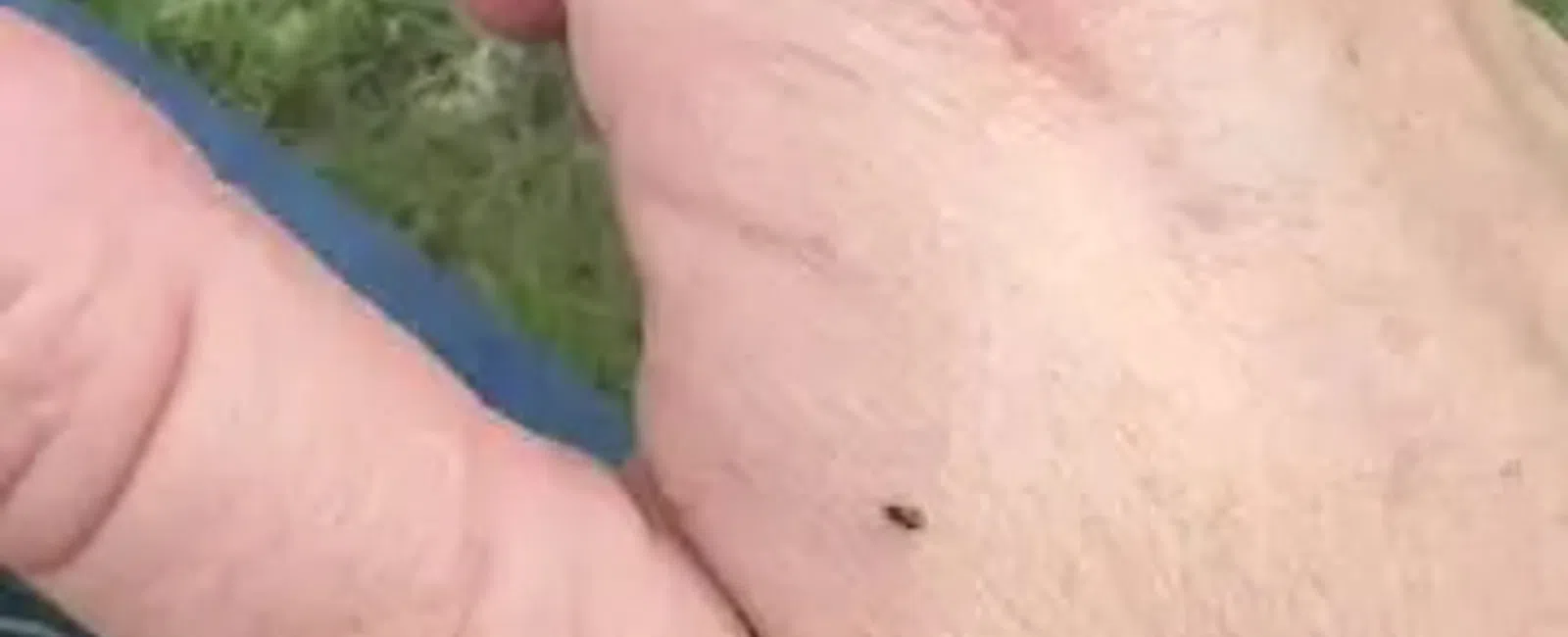
No-see-ums (also called biting midges, sand gnats, punkies, and noseeums) are tiny biting flies found throughout Florida. They are most prevalent in coastal areas, near wetlands, and in moist soil with decaying organic matter near water. South Florida's extensive canal system, coastal proximity, and year-round warm temperatures make Broward County, Miami-Dade, and Palm Beach County among the highest-pressure no-see-um environments in the country.
Their bites are disproportionately painful for their size. The reaction is often delayed, which leads many people to search for the insect biting them and find nothing.
What Are No-See-Ums?
No-see-ums are tiny biting flies in the family Ceratopogonidae, commonly called biting midges. They are approximately 1 to 3mm in length, small enough to pass through standard window screens, which is one reason they are particularly problematic. Despite their common name, they are visible under good light or magnification: small, gray flies with mottled wings held flat over the body when at rest.
Only the females bite. They require a blood meal to develop eggs, similar to mosquitoes. Males feed on plant nectar and do not bite. Females use blade-like mouthparts to cut through skin rather than piercing it, which is why their bites produce a sharper initial sensation than mosquito bites.
No-see-ums are most active at dawn and dusk, though in heavily infested areas, activity can continue throughout the day. Wind significantly suppresses their activity: they are weak fliers and cannot maintain flight in winds above 5-7 mph. On calm, humid evenings near water, populations can be so dense as to drive people indoors.
No-See-Um Bites: What to Expect
No-see-um bites are frequently misidentified because the insect is difficult to see and the reaction is often delayed.
Initial reaction. The bite produces an immediate, sharp burning or stinging sensation, often described as more intense than a mosquito bite, given the insect's size. Some people notice a small red spot or welt immediately after the bite.
Delayed reaction. A more significant reaction typically develops 12 to 24 hours after the bite, producing small, intensely itchy red welts or papules. This delayed onset leads many people not to associate the welt with the original bite, particularly when multiple bites are involved.
Duration. No-see-um bite reactions can persist for days to two weeks in sensitive individuals. The intense itching is the primary source of discomfort. Scratching increases the inflammatory response and extends the healing time.
Distinguishing no-see-um bites from other insects. No-see-um bites tend to appear in clusters on exposed skin, often on the ankles, lower legs, and arms, the areas closest to the ground where the insects concentrate. They are sometimes confused with:
- Bed bug bites, which also appear in clusters but are found on any skin area exposed during sleep, not specifically the lower extremities
- Mosquito bites, which typically produce larger, more immediate raised welts
- Sand flea bites, which concentrate heavily around the feet and ankles, may penetrate deeper into the skin
- Allergic reactions, which produce more diffuse hive-like patterns rather than discrete individual bite sites
Treating No-See-Um Bites
No treatment eliminates the bite reaction instantly, but several approaches reduce discomfort and duration.
- Topical antihistamine or hydrocortisone cream. Over-the-counter antihistamine creams (diphenhydramine) or low-concentration hydrocortisone cream applied directly to bite sites reduce itching and inflammation. Apply promptly after noticing bites rather than waiting for the full reaction to develop.
- Oral antihistamines. For multiple bites or a significant systemic reaction, oral antihistamines (cetirizine, loratadine, diphenhydramine) reduce the histamine-driven itch response. Non-drowsy formulations are appropriate for daytime use.
- Cold compress. Applying a cold pack or cold cloth to bite sites reduces local inflammation and provides temporary itch relief.
- Avoid scratching. Scratching no-see-um bites extends the healing time and raises the risk of secondary bacterial infection from broken skin. This is particularly relevant for the highly itchy bites that persist for a week or more in sensitive individuals.
- When to see a doctor. Most no-see-um bites resolve without medical treatment. Seek medical attention if bites show signs of secondary infection (increasing redness, warmth, swelling, or discharge), if a large number of bites trigger a systemic reaction (hives, swelling beyond the immediate bite site, difficulty breathing), or if bites do not resolve after two weeks.
No-See-Ums and Oropouche Virus: What Florida Residents Should Know
In 2024, the CDC identified biting midges as the primary vector for Oropouche virus, an arboviral disease previously considered confined to Central and South America. Locally acquired Oropouche cases were documented in the Americas, and Florida's biting midge population has come under increased surveillance as a result.
Oropouche virus causes a dengue-like illness with fever, headache, joint pain, and muscle aches. Most cases are self-limiting and resolve within a week, but severe neurological complications have been reported in a small number of cases. The Florida Department of Health monitors arboviral activity in biting midge populations as part of its ongoing surveillance program.
This does not significantly change the practical advice for no-see-um management. Reducing exposure, using repellents, and addressing breeding sites near the home remain the appropriate responses. However, it reinforces that no-see-ums in Florida are a public health concern beyond mere nuisance, particularly for outdoor workers, people who spend significant time near breeding habitats, and those traveling to or from areas with active Oropouche transmission.
Why South Florida Has Such High No-See-Um Pressure
Florida has among the highest biting midge populations in the continental United States, with coastal and wetland-adjacent communities experiencing the most intense activity.
- Breeding habitat. Biting midges breed in moist, organically rich soil at the margins of water bodies: canal banks, mangrove edges, salt marsh areas, pond margins, and any consistently wet soil near standing water. South Florida's extensive canal system, running through residential neighborhoods, creates breeding habitat distributed throughout densely populated areas rather than confined to natural wetland edges.
- Year-round activity. Unlike northern states, where biting midge populations decline sharply in winter, South Florida's climate sustains no-see-um activity throughout the year. Peak activity runs from late spring through fall, but warm winter conditions allow populations to remain active and continue breeding during what would otherwise be the off-season elsewhere.
- Coastal wind patterns. On-shore breezes in coastal communities carry no-see-ums inland from breeding sites along the Intracoastal Waterway, coastal canals, and beach-adjacent areas. Neighborhoods within several miles of the coast typically have higher no-see-um pressure than inland communities.
- Proximity to the Everglades and wetland systems. Western Broward County communities adjacent to Everglades drainage areas have exposure to biting midge populations from large wetland breeding areas that cannot be managed at the property level.
How to Get Rid of No-See-Ums: What Actually Works
No-see-um control is genuinely more difficult than mosquito control because the insects are smaller, breed in different environments, and cannot be controlled through the same approaches. Managing them requires a combination of personal protection, breeding site reduction, and, where feasible, targeted treatment.
Personal protection.
Repellents containing DEET at concentrations of 20% or higher are the most effective option for personal protection against biting midges. Products containing picaridin are also effective. Repellents marketed for mosquitoes also work on no-see-ums, though higher concentrations are more effective given the intensity of biting midge activity in South Florida.
Permethrin-treated clothing is an effective supplement. Permethrin applied to clothing kills biting midges on contact and provides protection that remains effective through multiple washes. This is particularly relevant for people who work outdoors or spend extended time near water.
Fine-mesh screens (18x18 mesh or finer) keep no-see-ums out of screened porches and living areas. Standard window screens (18x16 mesh) allow no-see-ums to pass through and are not effective barriers.
Reducing breeding habitat.
On-property breeding site management has a limited impact when the primary breeding habitat is the canal system or off-property wetland areas. However, any chronically wet soil on the property, particularly near the foundation or in low-lying areas that hold water after rain, contributes to on-property breeding pressure. Improving drainage, eliminating standing water, and reducing consistently moist soil near outdoor living areas reduces the immediate population.
Outdoor fans.
Because no-see-ums cannot fly in winds of 5 to 7 mph or higher, oscillating or directional fans on screened porches and outdoor living areas are among the most effective low-cost control measures for the immediate area. This does not reduce the population but makes the outdoor area significantly less hospitable during calm evening conditions.
Professional treatment.
Professional treatment of outdoor living areas focuses on residual spray applications to the vegetation and shaded resting sites where biting midges concentrate during the day. The same resting-site treatment approach used for mosquito control, targeting dense vegetation along fence lines, shrub bases, and shaded areas, reduces the adult biting midge population in the immediate yard.
Because no-see-ums often originate from off-property breeding sites, professional yard treatment reduces pressure from the local resting population but does not fully eliminate exposure from breeding sources that cannot be controlled at the property level. Combining professional treatment with repellent use and physical barriers (fine-mesh screens, fans) produces the most complete reduction in exposure.
Our mosquito control services include treatment programs that address both mosquitoes and biting midges in South Florida yards.
Scheduling a Treatment
If no-see-um activity is making your yard or outdoor living areas unusable during prime outdoor hours, a professional treatment program reduces the resident biting midge population alongside mosquito control.
Royal Pest & Termite is locally owned, based in Miramar, and has been serving South Florida homeowners since 2014. Our mosquito and biting insect control programs include residual treatment of resting vegetation and shaded areas on a recurring schedule calibrated for South Florida's year-round conditions.
Call us at (754) 202-4605 or schedule a free inspection online.
We serve Miramar, Pembroke Pines, Davie, Hollywood, Fort Lauderdale, Boca Raton, South Palm Beach County, and most of Broward County, FL. We also service select areas in northern Miami-Dade County. Call us to confirm availability at your address.