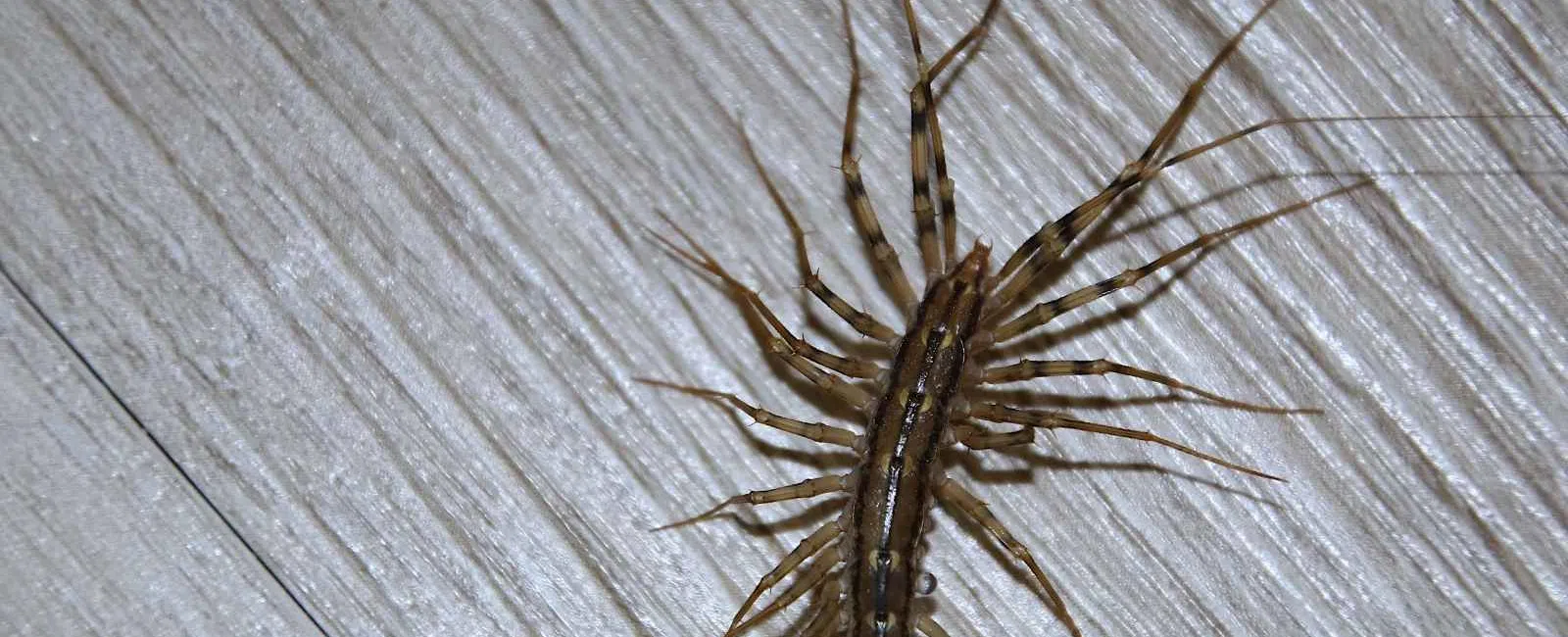
House centipedes are among the most startling insects South Florida homeowners encounter. They are fast-moving, multi-legged, and appear suddenly, usually at night in bathrooms, garages, and basements.
Despite their alarming appearance, they are not the threat most people assume them to be. They are, however, a reliable indicator of the moisture conditions and pest prey populations that sustain them indoors.
What Is a House Centipede?
The house centipede is a fast-moving arthropod with a flattened, elongated body approximately 1 to 1.5 inches long, surrounded by up to 15 pairs of long, banded legs. The legs extend well beyond the body width, giving the insect a distinctive appearance that makes it look significantly larger than it is. The body is yellowish-gray to brown, with darker longitudinal stripes running its length.
House centipedes move in rapid, darting bursts and can reach speeds that make them difficult to track across a floor. The back pair of legs is significantly longer than the front pair and can be mistaken for antennae, giving the appearance of legs on both ends.
Unlike outdoor centipedes and millipedes, the house centipede completes its entire lifecycle indoors and can live for several years under suitable conditions. A female can lay up to 150 eggs in a single season. Indoor populations that have access to moisture and prey can persist and grow without ever needing to venture outside.
Are House Centipedes Dangerous?
House centipedes are venomous; they use venom to subdue the insects they prey on. However, they are not medically significant to humans under normal circumstances.
A house centipede can bite a person if handled or cornered, but bites are rare and occur almost exclusively when the insect is directly handled or accidentally compressed against skin. The bite produces a sensation similar to a minor bee sting, with localized redness and swelling that typically resolves within a few hours. Severe reactions are uncommon and generally associated with individual sensitivity rather than the venom's potency.
For the vast majority of people, an encounter with a house centipede requires no medical attention. Individuals with known sensitivity to insect venom should exercise appropriate caution.
House centipedes are not aggressive. They do not pursue humans and will flee when disturbed. The instinct to run toward light or movement sometimes makes them appear to be moving toward a person, but this is not predatory behavior.
What Do House Centipedes Eat?
House centipedes are predators that feed on other insects and arthropods found in the home. Their prey includes cockroaches, silverfish, carpet beetles, ants, spiders, and other small insects.
This is relevant for two reasons. First, it means a house centipede infestation is almost never the primary pest problem; it is a response to an existing prey population. House centipedes do not establish indoors without a food source. Finding house centipedes consistently in a home indicates that other pest populations are present, even if they are not yet visible.
Second, house centipedes do not damage food, fabric, or structure. They are not destructive pests in the conventional sense. The problem they present is primarily the discomfort of encountering them and the signals their presence sends about the broader pest environment.
Why House Centipedes Are in Your South Florida Home
Two conditions sustain house centipedes indoors: moisture and prey. South Florida's climate creates both in abundance.
Moisture. House centipedes require high humidity to survive and desiccate quickly in dry conditions. They are drawn to the most humid areas of the home, bathrooms, under-sink areas, laundry rooms, garages, and any space with plumbing or condensation. South Florida's ambient humidity, combined with the consistently warm temperatures that prevent the drying conditions that kill centipedes in cooler climates, makes homes here significantly more hospitable than homes in drier regions.
Moisture problems that increase house centipede pressure include leaking pipes under sinks, condensation on cold water supply lines, poor ventilation in bathrooms and laundry areas, and chronic dampness in the garage or utility spaces.
Prey. The insects that house centipedes feed on, cockroaches, silverfish, ants, and other small arthropods, are common in South Florida homes. A property with active cockroach or ant pressure has a ready food supply that sustains house centipede populations. Addressing prey populations is a direct way to reduce centipede pressure alongside moisture management.
Entry points. House centipedes enter from outside through gaps in foundations, utility penetrations, and any opening that connects the exterior to the interior. In South Florida's older homes with block construction, aging caulk around pipe penetrations and gaps in the foundation are common entry routes. Once inside, they establish in moisture-rich areas and rarely need to return outdoors if conditions are favorable.
How to Get Rid of House Centipedes
Effective control addresses the conditions sustaining them, not just the individual insects encountered.
- Reduce moisture indoors. Fix any leaking pipes or supply lines, particularly under sinks and in utility rooms. Improve bathroom ventilation, exhaust fans that actually vent to the exterior rather than into the attic. Address condensation on cold-water supply lines by installing pipe insulation where feasible. In garages and utility spaces, a dehumidifier can reduce ambient humidity to levels that make the environment less hospitable.
- Eliminate prey populations. A general pest control program that directly targets cockroaches, silverfish, ants, and other prey species reduces the food supply that sustains centipede populations. House centipede numbers decline when the prey they depend on is no longer available in sufficient quantities.
- Seal entry points. Caulk gaps around pipe penetrations through the foundation and exterior walls. Replace worn door sweeps on garage and exterior doors. Check the seal around utility line entry points. Reducing structural access reduces both house centipede entry and the entry of the prey species they follow indoors.
- Reduce outdoor harborage near entry points. Leaf litter, mulch pressed against the foundation, and debris piles adjacent to the structure provide outdoor harborage where house centipedes and their prey congregate before entering. Pulling mulch back from the foundation and clearing debris near entry points reduces the population immediately outside the home.
- Targeted treatment. Residual insecticide applied to entry points, baseboards in affected areas, and the perimeter of moisture-prone rooms reduces house centipede activity. Treatment is more effective as a supplement to moisture and prey control than as a standalone measure. Chemical treatment without addressing the underlying conditions produces inconsistent results.
Our general pest control programs address the full picture: perimeter treatment, entry-point assessment, and management of prey populations that draw house centipedes indoors.
House Centipedes vs. Other Centipedes and Millipedes
House centipedes are frequently confused with other multi-legged arthropods found in South Florida. The distinction matters because behavior and treatment differ.
House centipede vs. outdoor centipede. Outdoor centipedes (the red-headed or common garden centipede) are typically larger, darker, and found in soil and leaf litter outdoors. They enter homes opportunistically but do not establish indoors the way house centipedes do. An outdoor centipede indoors is likely a stray; a house centipede indoors indicates an established indoor population.
House centipede vs. millipede. Millipedes are slower-moving, darker, and have two pairs of legs per body segment rather than one. They are detritivores that feed on decaying organic matter rather than predators. Millipedes that enter South Florida homes are typically seeking moisture and are most common after heavy rain. They do not bite and do not establish indoors.
House centipede vs. silverfish. Silverfish are silver-gray, carrot-shaped, and wingless with three tail-like appendages. They are sometimes confused with house centipedes because both are found in the same moisture-prone environments. Silverfish damage paper, fabric, and starchy materials; house centipedes prey on silverfish. Finding both indicates a moisture problem with established indoor pest populations.
Schedule a Pest Inspection
Consistent house centipede activity is a signal worth investigating. The prey populations and moisture conditions that sustain centipedes indoors are often addressable through a single professional assessment that identifies the root cause.
Royal Pest & Termite is locally owned, based in Miramar, and has been serving South Florida homes since 2014. Our general pest control programs address the full range of pest species found in Broward County and surrounding South Florida communities.
Call us at (754) 202-4605 or schedule a free inspection online.
We serve Miramar, Pembroke Pines, Davie, Hollywood, Fort Lauderdale, Boca Raton, South Palm Beach County, and most of Broward County, FL. We also service select areas in northern Miami-Dade County. Call us to confirm availability at your address.