If you live in Miramar, Pembroke Pines, or anywhere in Broward County, you know the routine. You spend your Saturday morning at the big-box store, load up the cart with "guaranteed" weed killer and bug spray, spend hours sweating in the Florida sun, and by Tuesday, the weeds are taller, and the ants are marching across your kitchen counter.
It feels like throwing money into a tropical storm.
At Royal Pest & Termite, we hear this story every day. People call us because they're exhausted from the DIY loop, or because they hired a budget service that promised results and delivered a yard full of dollarweed and a house full of roaches. The truth is, South Florida is the final boss of lawn care and pest control. What works in Georgia or Ohio doesn't cut it here. Here's exactly why it keeps failing, and what actually fixes it.
1. The South Florida Climate Is Working Against You
Our climate is basically a year-round luxury spa day for pests and weeds. With 90-degree heat and near-constant humidity, biological processes run at full speed. Weeds grow faster here than almost anywhere else in the country. Pests breed continuously because we don't get the hard freeze that thins populations in cooler climates.
Most off-the-shelf products are formulated for a national average climate, not for a Broward County summer. UV intensity breaks down active ingredients faster than the label accounts for. By the time you've finished spraying a section of your yard, the Florida sun has already started degrading what you applied at the start.
The fix: Professional-grade products formulated for tropical environments have UV-stabilized carriers and longer residual windows specifically to account for this. They're built to last through what South Florida throws at them.
2. Misidentifying the Pest (The Crazy Ant Problem)
Identification is 90% of the battle in pest control, and this is where most DIY attempts fail before they start.
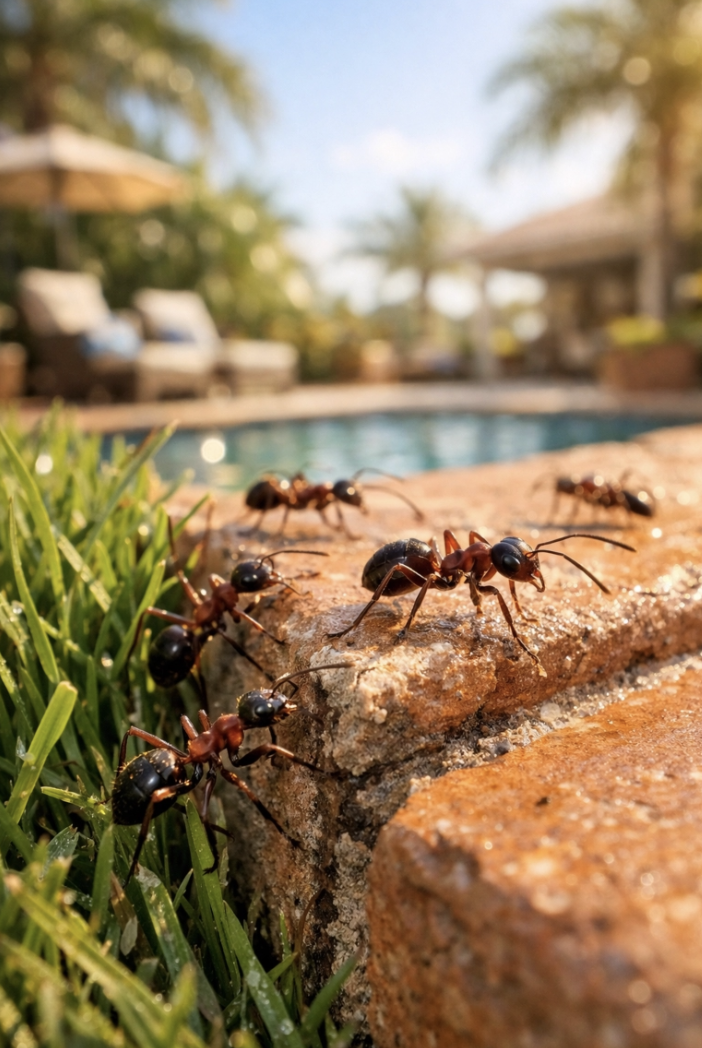
Take the Caribbean crazy ant as the clearest example. These ants don't follow neat trails like most species. If you spray them with a standard repellent, you trigger "budding": the colony detects a threat, the queens split up, and you've turned one infestation into three or four. Using the wrong product on the wrong pest is the fastest way to make a problem worse.
The same logic applies to weed control. Treating dollarweed the same way you'd treat crabgrass doesn't work. They require different active ingredients and application methods. Misidentification costs money and time while the real problem grows.
The fix: Correct identification before any treatment is applied. Our technicians are trained to distinguish between ghost ants, big-headed ants, fire ants, and crazy ants, as well as the weeds common to St. Augustine lawns in Broward County. Each pest and each weed species requires its own strategy.
3. Bad Timing: The Afternoon Downpour Problem
We've all seen it. You finish treating the lawn, and 20 minutes later, a South Florida thunderstorm rolls in. If you applied a liquid treatment right before the rain, you didn't treat your lawn. You treated the neighborhood drainage canal.
Timing is one of the most overlooked variables in effective lawn pest control and weed control. Most liquid treatments need a minimum dry time of 30 to 60 minutes to bond with the soil or plant surface. Apply them at the wrong time, and the product washes away before it can do anything.
The fix: Scheduling matters. We monitor local weather patterns for the Miramar and Pembroke Pines areas specifically and time treatments to ensure enough dry time before the next rain event. Granular treatments can often provide more flexibility on timing, but they still need to be watered in correctly, not just rained on immediately after application.
4. Treating the Surface, Not the Source
When you see a cockroach in the kitchen and spray it with a can of Raid, you've eliminated one bug. For every one you see, there are likely dozens or hundreds more hiding in wall voids, behind the dishwasher, or in the attic.
Surface-level treatments are a temporary fix. They don't reach nests, breeding sites, or the reproductive queens driving population growth. This is especially true for German cockroach infestations, where the visible roaches are a fraction of the actual colony.
The same principle applies to lawn weeds. Pulling dollarweed by hand or spot-spraying the tops without addressing the root structure means regrowth within days.
The fix: We focus on source reduction. For pests, that means baits and insect growth regulators that foragers carry back to the nest, eliminating the colony at the root, not just the workers you can see. For weeds, it means systemic herbicides that move through the plant to the root system and appropriate pre-emergent treatments to prevent germination.
5. Subcontracted Work, Inconsistent Results
This is a significant problem in the South Florida pest control industry. Many large companies sell you a service contract, then subcontract the actual work to a third party. The technician who shows up may not be state-licensed. They may be paid per stop rather than per quality of work, which means they're incentivized to move fast, not to be thorough.
You have no way of knowing whether the person treating your home has any relationship with the company you hired or any stake in whether the treatment actually works.
The fix: At Royal Pest & Termite, we handle everything in-house. Every technician who comes to your property is a Royal employee, state-licensed, and works in the same Broward County communities they serve. When you call us, you're talking to the people who actually do the work.
6. Harsh Products That Aren't Safe for Pets or Kids
South Florida homeowners love their pets, and many budget services and older-generation DIY products put pet safety at odds with effectiveness. Older pesticide formulations remain wet or dusty for extended periods, leading many homeowners to deliberately under-apply the product to avoid exposing their dogs or cats.

Under-application is often worse than no application at all. It creates enough chemical presence to stress a pest population without actually controlling it, leading to resistance over time. And it still poses an exposure risk to your pets.
This is a real tension: you want pest control that's safe for pets but also effective enough to actually solve the problem. The answer isn't choosing one over the other.
The fix: Modern, low-impact professional products are formulated to be highly targeted against specific pests and safe for pets and children once dry (which, in South Florida's heat, is usually 30 to 60 minutes). We use pet-safe pest control products across all of our residential services. Our founder started this company with a dog, and pet safety is built into how we choose every product we apply, not tacked on as a selling point.
7. Using the Wrong Equipment for St. Augustine Lawns
A hand-pump sprayer from the hardware store cannot deliver the coverage or penetration that South Florida's thick St. Augustine lawns require. The thatch layer in a mature St. Augustine lawn (the dense layer of accumulated organic matter between the grass blades and the soil) can be an inch or more deep. That's where chinch bugs, grubs, and other turf pests live and breed.
If the product doesn't physically reach the target zone, it doesn't work, regardless of what's in it.
The fix: Our turf care equipment is calibrated to deliver the right pressure and volume to penetrate the thatch layer and reach the soil and root zone where lawn pests actually live. Equipment calibration is a professional skill that removes the guesswork from application rates and coverage.
8. Ignoring Entry Points (How They're Getting In)
You can treat the interior of your home thoroughly, but if you have gaps under your doors, cracks in the foundation, unsealed utility penetrations, or tree branches touching your roofline, pests have direct access that no interior spray can address.
Effective pest control is as much about exclusion (physically preventing access) as it is about chemical treatment. One without the other is always an incomplete solution.
The fix: During our initial inspection, we identify entry points alongside the active pest issues. A gap under a door sweep, an unsealed utility line entry point, or overhanging vegetation creating a bridge from your yard to your exterior wall: these are part of what we document and address. Closing the door before treating inside is how you keep results from backsliding.
9. Your Property Is Running a 24/7 Pest Buffet
Even the best professional treatment program struggles to compete with a free, continuous supply of food and water. Standing water in gutters or low spots, pet food left out on the patio, uncovered compost, open trash cans, grease residue on an outdoor grill: any of these can undermine a treatment within days.
In Broward County specifically, the combination of irrigation systems, canal-adjacent properties, and dense landscaping creates persistent moisture conditions that attract and sustain pest populations regardless of what's been sprayed.
The fix: A good inspection includes an honest assessment of environmental factors that are actively working against your treatment. We'll flag the standing water spots, the overgrown shrubbery acting as a pest highway, and the conditions that need to change for any treatment to hold. This isn't upselling. It's what separates a treatment that lasts from one that you have to repeat every three weeks.
10. Retail-Strength Products Are Formulated for Consumer Safety, Not Pest Elimination
The products sold in hardware stores are diluted to consumer-safe concentrations, making them appropriate for self-application by untrained homeowners. That's a reasonable regulatory choice, but it means they often aren't concentrated enough to handle established infestations or aggressive weed populations in South Florida's conditions.
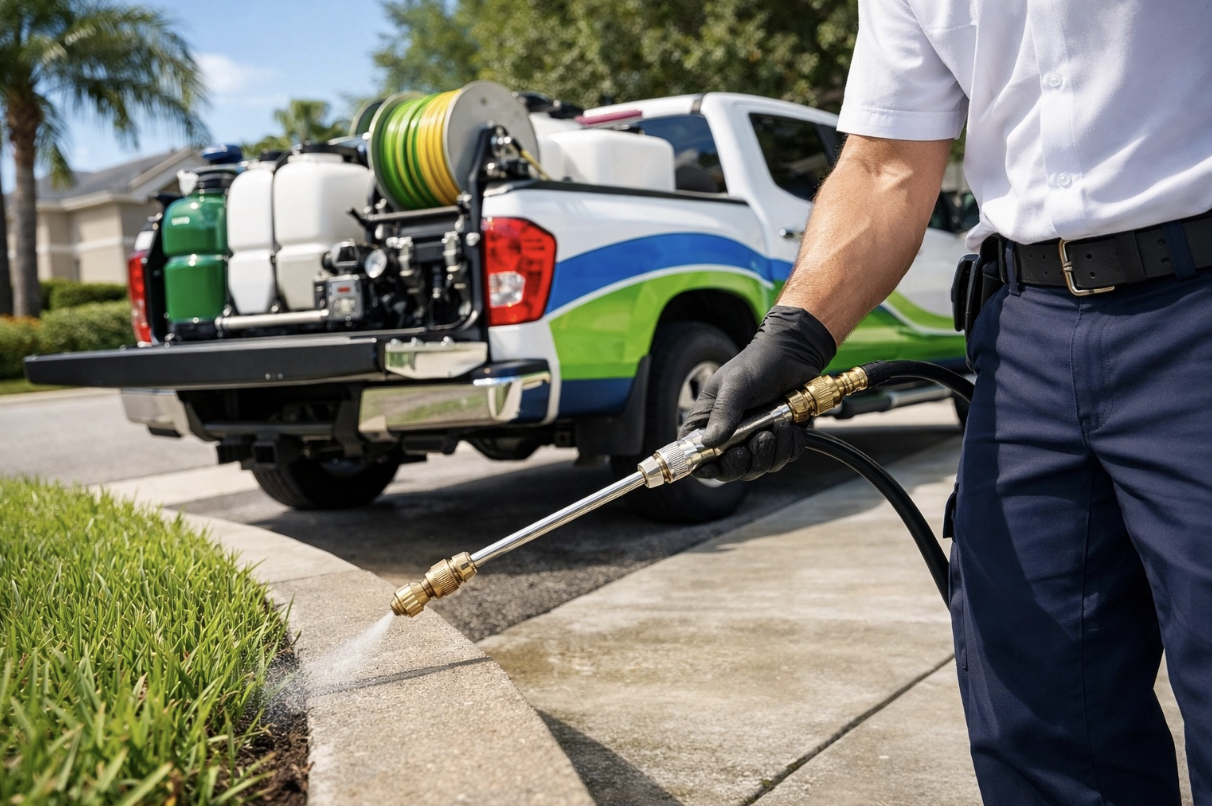
It's the difference between an over-the-counter pain reliever and a prescription-strength treatment. For a mild issue, the OTC version may work. For a serious infestation or a lawn with an aggressive weed problem built up over a full growing season, retail-strength products often aren't enough.
The fix: Professional-grade products are available only to licensed applicators, are more targeted to specific pest and weed species, and maintain effective residual activity longer in South Florida's climate. They represent a meaningfully better return on investment than repeated retail purchases that partially work.
Why Royal Pest & Termite
We're not a national franchise with a local phone number. We're locally owned, based in Miramar, and have been serving Broward County and surrounding South Florida communities since 2014. We know the difference between how a lawn in Silver Lakes behaves and how one in West Hollywood behaves. We know the pest pressure patterns in Davie, the soil conditions in Pembroke Pines, and the weed species that dominate St. Augustine lawns across the county.
Our lawn care services and general pest control are handled entirely in-house by our own state-licensed technicians, never subcontracted. And if the pests or weeds come back between scheduled visits, so do we, at no extra charge.
If you're searching for lawn and pest control near me and want someone who actually knows your neighborhood, that's what we're built for.
Ready to Stop Fighting Your Lawn and Home?
Don't spend another weekend losing to Florida's heat, weeds, and bugs. Let us take a look and give you an honest, no-pressure assessment of what's actually going on and what it takes to fix it.
Call Royal Pest & Termite at (754) 202-4605 or request your free inspection online. Whether you need pest control in Miramar, Pembroke Pines, Davie, Hollywood, or anywhere across Broward County, we're ready to help.
We serve Miramar, Pembroke Pines, Davie, Hollywood, Fort Lauderdale, Boca Raton, South Palm Beach County, and most of Broward County, FL. We also service select areas in northern Miami-Dade County. Call us to confirm availability at your address.