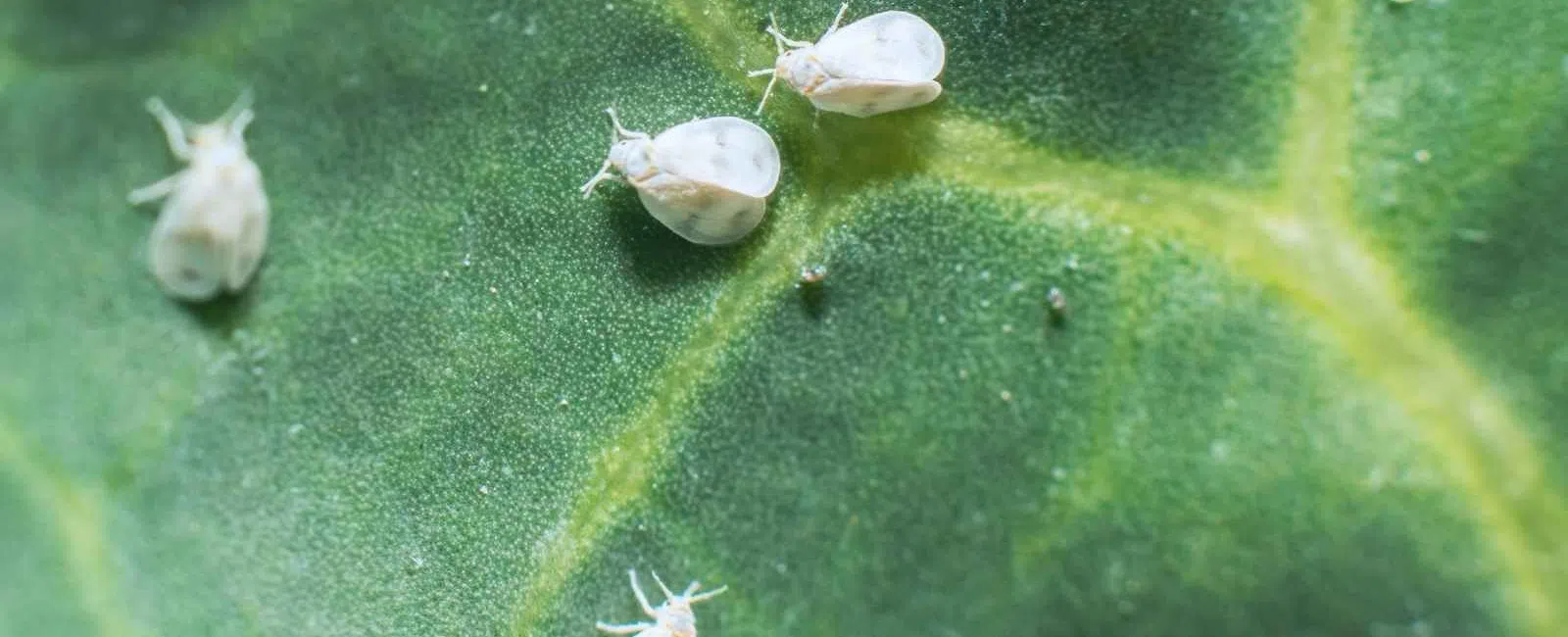
Whiteflies are one of the most damaging landscape pests in South Florida. They are present year-round in Broward County, Miami-Dade, and Palm Beach County, and their populations can build rapidly on hedges, ornamental shrubs, and flowering plants. Left untreated, severe whitefly infestations defoliate plants entirely and can kill established hedges and trees over one to two seasons.
The ficus whitefly in particular has caused widespread destruction of ficus hedges, one of the most common privacy plantings in South Florida's residential communities, since its arrival in Florida around 2007. For homeowners who invested in mature ficus hedges, whitefly damage is one of the most costly unmanaged landscape pest problems in the region.
What Are Whiteflies?
Whiteflies are small, soft-bodied insects closely related to aphids and scale insects. Adults are approximately 1 to 2mm long, with white, powdery wings that they hold flat across their back when at rest. Despite their name, whiteflies are not true flies; they are more closely related to mealybugs and other sap-feeding insects.
Several whitefly species are active in South Florida, each with a preferred host plant:
- Ficus whitefly. The ficus whitefly targets ficus trees and hedges almost exclusively. It arrived in South Florida around 2007 and spread rapidly throughout the region. A heavy infestation causes ficus hedges to drop their leaves and, without treatment, can kill established plants over one to two seasons. It is the most destructive whitefly species in South Florida's residential landscapes.
- Rugose spiraling whitefly. This species arrived in Florida around 2009 and feeds on a wide range of host plants, including gumbo limbo, palms, black olive, bird-of-paradise, and many ornamentals. It is identified by the distinctive white, waxy spiral patterns it leaves on the underside of leaves. While it rarely kills established trees and shrubs on its own, heavy infestations cause significant aesthetic damage and weaken plants.
- Silverleaf whitefly. This species is a major pest of vegetable gardens and some ornamental plants. It causes both direct feeding damage and indirect damage by transmitting plant viruses. It is the species most commonly associated with whitefly damage in home gardens across South Florida.
- Fern whitefly, bondar's nesting whitefly, and others. South Florida hosts additional whitefly species with more specialized host ranges, including species targeting palms, ornamental ferns, and certain shrubs.
Identifying a Whitefly Infestation
Whitefly infestations are typically identified through a combination of plant symptoms and direct observation of the insects.
- Yellowing or pale leaves. Whiteflies feed by piercing leaf tissue and extracting plant sap. Heavy feeding causes leaves to yellow, lose color, and drop prematurely. On ficus hedges, this presents as progressive defoliation starting from the interior of the hedge and spreading outward.
- Sticky residue on leaves and surfaces below. As whiteflies feed, they excrete a sugary waste product called honeydew. Honeydew accumulates on the upper surfaces of leaves below the infested foliage and on surfaces under the plant, patio furniture, pavers, and cars. Sooty mold, a dark fungal growth that feeds on honeydew, develops on these surfaces and further reduces the plant's photosynthetic capacity.
- White, waxy debris on leaf undersides. Adult whiteflies, eggs, and the flattened nymphs (called crawlers) are found on the underside of leaves. On rugose spiraling whitefly infestations, the distinctive white waxy spirals are clearly visible. On other species, the underside of leaves will show a fine white powdery coating and tiny insects visible under magnification.
- Cloud of white insects when the plant is disturbed. Adult whiteflies take flight when the plant is disturbed. If brushing or shaking a plant causes a cloud of small white insects to rise, an adult whitefly population is present.
- Ants on infested plants. Like aphids, whiteflies produce honeydew that attracts ants. Ants actively tend to whitefly populations and protect them from natural predators, thereby accelerating infestation. Finding ants actively running on an ornamental plant is sometimes the first visible signal of a whitefly infestation on the underside of leaves.
Why Whitefly Populations Build So Rapidly in South Florida
South Florida's climate creates conditions where whitefly populations can increase from light pressure to severe infestation in a matter of weeks.
- Year-round breeding. Whiteflies complete their lifecycle from egg to adult in as little as 3 to 4 weeks in Florida's heat. With no winter interruption, multiple generations overlap continuously throughout the year. A small founding population in spring can produce a severe infestation by summer.
- No meaningful natural predator pressure on introduced species. The ficus whitefly and rugose spiraling whitefly are invasive species without established natural predator populations in Florida at the scale needed to suppress outbreaks. Natural enemies exist, but cannot keep pace with rapid population growth on heavily infested properties.
- Dense ornamental planting. South Florida's residential landscapes often feature dense ficus hedges, hibiscus borders, and massed ornamental plantings that create continuous host material adjacent to infested plants. Once established in a hedge, whiteflies can rapidly spread to adjacent sections.
- Resistance in some populations. Certain whitefly populations, particularly the silverleaf whitefly, have developed resistance to some commonly used insecticide classes. Products that were effective five years ago may yield inconsistent results against resistant populations, contributing to repeated treatments with diminishing results.
Effective Whitefly Control: What Professional Treatment Involves
Professional whitefly treatment uses a combination of systemic insecticides and contact treatments applied with equipment capable of achieving adequate coverage on dense ornamental plantings.
Systemic treatments can be applied as soil drenches around the root zone, as trunk or stem injections on larger plants, or as foliar applications with systemic activity. The appropriate method depends on the plant species, size, and the severity of infestation. Soil drench applications are particularly effective for established ficus hedges because the plant's root system distributes the active ingredient throughout the canopy.
- Insect growth regulators (IGRs). IGR products disrupt the development of whitefly nymphs, preventing them from maturing into reproducing adults. Used in combination with insecticides targeting adult populations, IGRs break the breeding cycle at the source.
- Horticultural oil and insecticidal soap. For lighter infestations or as a supplement to systemic treatment, horticultural oil and insecticidal soap, applied with adequate coverage to the undersides of leaves, suffocate soft-bodied adults, nymphs, and eggs on contact. These products have no residual activity and require thorough coverage to be effective, which typically requires professional application equipment for dense hedges.
- Ant control as a component of whitefly management. Because ants actively protect whitefly populations from natural predators, controlling ant activity on infested plants is an important component of a comprehensive program. Our ant control services can be coordinated with landscape treatment to break this protective relationship and allow natural predator populations to help suppress ants.
- Recurring treatment schedule. Given the rapid whitefly breeding cycle and continuous reinfestation pressure in South Florida, a single treatment rarely maintains control for more than 4 to 8 weeks. Professional whitefly programs typically schedule follow-up applications at 4- to 6-week intervals throughout the active season, transitioning to quarterly maintenance once the infestation is suppressed.
Our lawn care and landscape pest services include whitefly treatment for ficus hedges, hibiscus, ornamental shrubs, and other commonly affected plants throughout Broward County and surrounding South Florida communities.
Ficus Whitefly: South Florida's Most Destructive Landscape Pest
The ficus whitefly deserves specific attention because of the scale of damage it has caused to South Florida's residential landscapes since its arrival.
Ficus hedges, particularly the common ficus species used widely for privacy screens throughout Broward and Miami-Dade Counties, are the exclusive host of this whitefly species. A heavy infestation can cause complete defoliation within a matter of weeks under peak summer conditions. Plants that are defoliated repeatedly without treatment will die, leaving homeowners with the significant expense of removing and replacing mature hedge plantings.
Early intervention is the most cost-effective approach. A ficus hedge showing early yellowing and leaf drop, with visible insects on the undersides of the leaves, can typically be saved with prompt, appropriate treatment. A hedge that has been severely defoliated multiple times with woody dieback may require replacement regardless of treatment.
Signs that a ficus hedge has ficus whitefly rather than a cultural problem:
- Leaf drop is progressing through the hedge from the inside outward
- White, powdery coating visible on the underside of remaining leaves
- A cloud of small white insects is released when branches are shaken
- Honeydew accumulation and sooty mold on lower leaves and surfaces below the hedge
- Ants actively foraging on the stems and leaf surfaces
If you are seeing these signs, treatment should begin promptly rather than waiting for the next scheduled service visit.
Schedule a Landscape Pest Inspection
Whitefly infestations progress quickly in South Florida's climate. Early treatment is significantly less costly than attempting to recover severely damaged or defoliated plantings.
Royal Pest & Termite is locally owned, based in Miramar, and has been providing landscape pest and lawn care services throughout South Florida since 2014. Our technicians assess the extent of whitefly infestation, identify the species present, and recommend a treatment approach appropriate for your specific plants and conditions.
Call us at (754) 202-4607 or schedule a free inspection online.
We serve Miramar, Pembroke Pines, Davie, Hollywood, Fort Lauderdale, Boca Raton, South Palm Beach County, and most of Broward County, FL. We also service select areas in northern Miami-Dade County. Call us to confirm availability at your address.