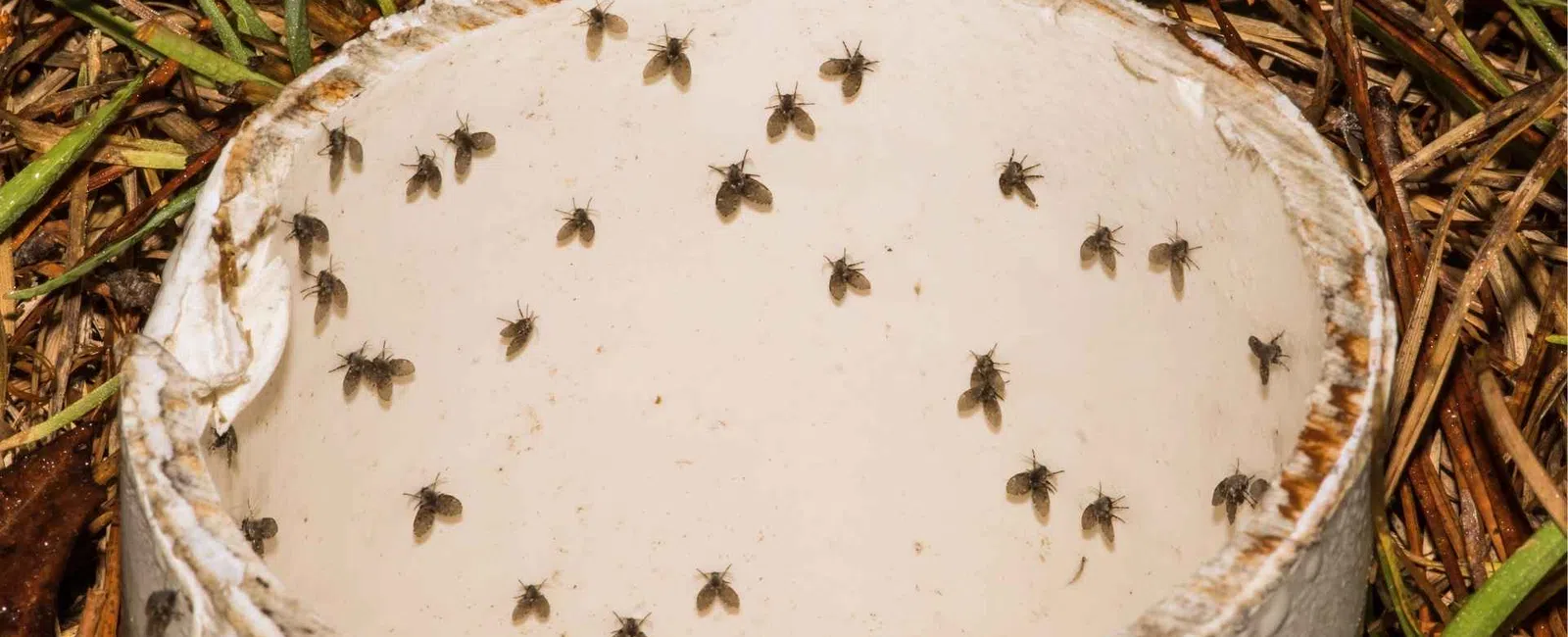
Drain flies are small, moth-like flies that breed in the organic slime that accumulates inside drains, pipes, and other moist environments with decaying organic matter. They are a frequent household pest complaint in South Florida, where the warm, humid climate accelerates the development of the organic biofilm they need to breed and speeds up their lifecycle year-round.
They are not dangerous and do not bite, but they are persistent. Because most homeowners treat only the adult flies they see rather than the breeding source in the drain, drain fly problems tend to recur for weeks or months without fully resolving.
What Do Drain Flies Look Like?
Drain flies are small, approximately 1/8 inch long, with fuzzy, moth-like wings that they hold flat and tent-like over their bodies when at rest. They are gray to tan in color with a distinctive fuzzy or powdery appearance due to the fine hairs covering their wings and bodies. When disturbed, they take short, erratic hops rather than flying long distances.
They are commonly mistaken for fungus gnats and fruit flies. The distinction matters because each pest has a different breeding source and requires a different treatment approach.
Drain Flies vs. Fungus Gnats vs. Fruit Flies
Three small fly species are frequently confused in South Florida homes. Correct identification before treatment prevents wasted time and product.
- Drain flies have broad, fuzzy, moth-like wings held flat over the body. They are found near drains, pipes, and anywhere with moist organic matter, such as bathroom sinks, kitchen sinks, floor drains, and sump pits. Their larvae live in the gelatinous slime inside drain pipes.
- Fungus gnats are slender, dark-bodied flies with long legs and wings held along the body rather than flat. They breed in moist potting soil where organic matter is decomposing near the soil surface; houseplants and outdoor planters are the most common sources. They do not breed in drains. If the flies appear near houseplants rather than sinks, fungus gnats are the more likely identification.
- Fruit flies are small, rounded flies with distinctive red eyes. They breed in overripe fruit, fermenting liquids, and the organic residue inside drains and recycling bins. They are attracted to fruit and fermentation sources. If the flies appear most heavily around fruit bowls, wine bottles, and recycling, fruit flies are the most likely identification.
The simplest field test: place a piece of tape, sticky side down, over the drain opening overnight. Drain flies emerging from the drain will stick to the tape. If the tape is clean but flies are still present, the breeding source is elsewhere.
Why South Florida Homes Are Particularly Susceptible
South Florida's climate creates conditions that accelerate the drain fly lifecycle and the decomposition of organic matter simultaneously.
- Year-round warmth. Drain flies complete their lifecycle from egg to adult in 7 to 28 days, depending on temperature. In South Florida's consistently warm climate, the lifecycle runs at the faster end of that range year-round. There is no winter slowdown in drain fly development, the way there is in cooler climates.
- High humidity. The moist, humid conditions in South Florida bathrooms and kitchens maintain the wet organic slime inside drains in an ideal state for drain fly larvae. In drier climates, organic buildup in pipes partially desiccates during dry periods, reducing larval survival. In South Florida, humidity keeps pipes continuously moist.
- Aging plumbing in established neighborhoods. Many of Broward County's older residential communities have plumbing infrastructure that has accumulated years of organic buildup inside pipe walls. Older pipes with rough interior surfaces accumulate more biofilm than newer, smooth-interior pipes. Homes that have not had drain cleaning service in Broward County in several years often have significant organic buildup in secondary drains, floor drains, utility sink drains, and seldom-used bathroom drains, which serve as persistent breeding sites for drain flies.
- Rarely used drains. Any drain that is not flushed regularly can develop the standing organic matter that drain fly larvae need. Floor drains in garages, laundry rooms, and guest bathrooms, as well as drains in vacation properties or in second bathrooms used infrequently, are common, often overlooked breeding sites.
Finding the Drain Fly Breeding Source
Eliminating drain flies requires locating and treating the breeding source, not just killing the adult flies. Adults can be knocked down with a spray, but the larvae in the drain continue developing, and the population rebuilds within days.
Step 1: Identify all potential breeding sites. Drain flies can breed in any of the following:
- Bathroom sink and shower drains
- Kitchen sink drains
- Floor drains in laundry rooms, garages, and utility areas
- Sump pits
- Condensate drain lines from air conditioning units
- Septic system access points
- Seldom-used drains in guest bathrooms
- Standing water in drip trays or under refrigerators
Step 2: Use the tape test. Cover each potential drain with tape (sticky side down) and leave it overnight. Adult drain flies emerging from the drain will stick to the tape. Check each covered drain the following morning. The drains with flies on the tape are the active breeding sites. Drains without flies may still have larvae present if slime is present, but they are not the primary active sources.
Step 3: Inspect the interior of the drain. Using a flashlight and a drain stick or pipe brush, check the interiors of the identified drains for the gelatinous gray-brown slime that indicates organic buildup and a drain fly breeding habitat. Even a thin coating on the pipe walls can support a drain fly population.
How to Get Rid of Drain Flies
Effective drain fly control requires physically removing the organic breeding material from the drain, not just applying a treatment to the drain opening.
Step 1: Mechanical cleaning. Use a drain brush or pipe cleaning tool to scrub the interior walls of the drain pipe and the underside of the drain stopper. The goal is to physically remove the organic biofilm in which larvae are living. Flushing with hot water alone is not sufficient; the slime must be mechanically disrupted and removed. For floor drains, a stiff brush that can reach the pipe walls is necessary.
Step 2: Application of the drain cleaning product. After mechanical cleaning, apply a drain gel product containing microbial or enzymatic active ingredients designed to break down organic matter inside pipe walls. These products work by digesting the organic material rather than simply flushing it through. They require dwell time in the drain and should not be followed immediately by running water. Apply in the evening after the drain has not been used for several hours.
Avoid bleach and boiling water as treatments for drain flies. Bleach temporarily affects larvae near the drain opening but does not penetrate the biofilm coating the pipe walls further down. Boiling water can damage pipes and does not remove the biofilm that remains after larvae are killed.
Step 3: Address adult flies. Once the breeding source is treated, adult flies present in the home will die off within their natural lifespan of approximately 20 days without reproducing. Small sticky traps near the affected drains can help capture adults during this period. If adult populations are high enough to require more rapid knockdown, a brief application of a pyrethrin-based space spray in the affected room reduces adult numbers.
Step 4: Repeat as needed. A single drain-cleaning treatment may not fully remove all organic material from a heavily built-up drain. Weekly application of enzymatic drain cleaner for two to four weeks maintains treatment pressure on any remaining organic matter and prevents the biofilm from rebuilding.
When Drain Flies Are Coming from Outside the Home
In South Florida, drain flies occasionally enter homes from exterior sources rather than from interior drains. Sources include:
- Condensate drain lines. Air conditioning condensate drain lines that terminate near the foundation can develop organic buildup in the line itself or in the soil where the condensate exits. Drain flies breeding in a condensate line can enter the home through gaps around the line where it passes through the wall.
- Septic systems and sewer access points. Homes with septic systems or older sewer infrastructure may have drain flies emerging from septic access points or sewer cleanout pipes near the foundation. If interior drain treatment does not resolve the infestation, exterior sources should be investigated.
- Neighboring or shared plumbing. In multi-family residential buildings, drain flies can travel between units through shared drain lines and emerge from floor drains or unused fixtures in adjacent spaces.
If drain fly activity persists after a thorough interior drain treatment, a professional inspection can identify exterior or structural sources that are inaccessible through standard drain cleaning.
When to Call a Professional
Most drain fly infestations can be resolved through thorough mechanical cleaning and enzymatic drain treatment. A professional inspection is appropriate when:
- Drain fly activity persists after four weeks of consistent drain cleaning treatment
- Flies are present, but no interior drain breeding source can be identified
- The infestation appears to be entering from an exterior or structural source
- The home has a septic system with access points near the structure
- Commercial or multi-unit properties require treatment of shared drain infrastructure
Royal Pest & Termite is locally owned, based in Miramar, and has been providing pest control services throughout South Florida since 2014. Our general pest control programs address persistent fly infestations when standard drain treatment has not resolved the problem, and our technicians can identify non-obvious breeding sources through a thorough inspection.
Call us at (754) 202-4605 or schedule a free inspection online.
We serve Miramar, Pembroke Pines, Davie, Hollywood, Fort Lauderdale, Boca Raton, South Palm Beach County, and most of Broward County, FL. We also service select areas in northern Miami-Dade County. Call us to confirm availability at your address.